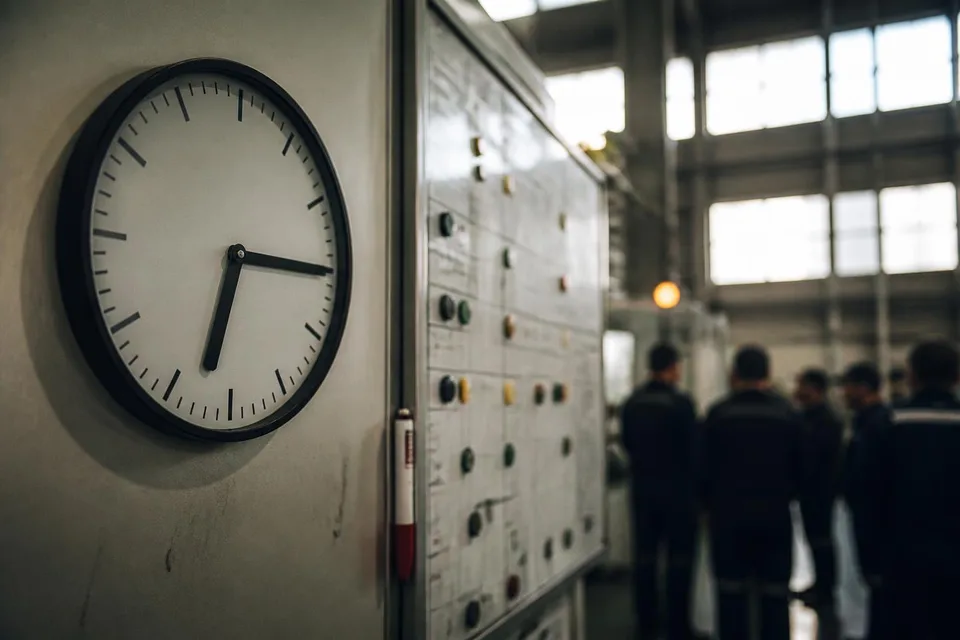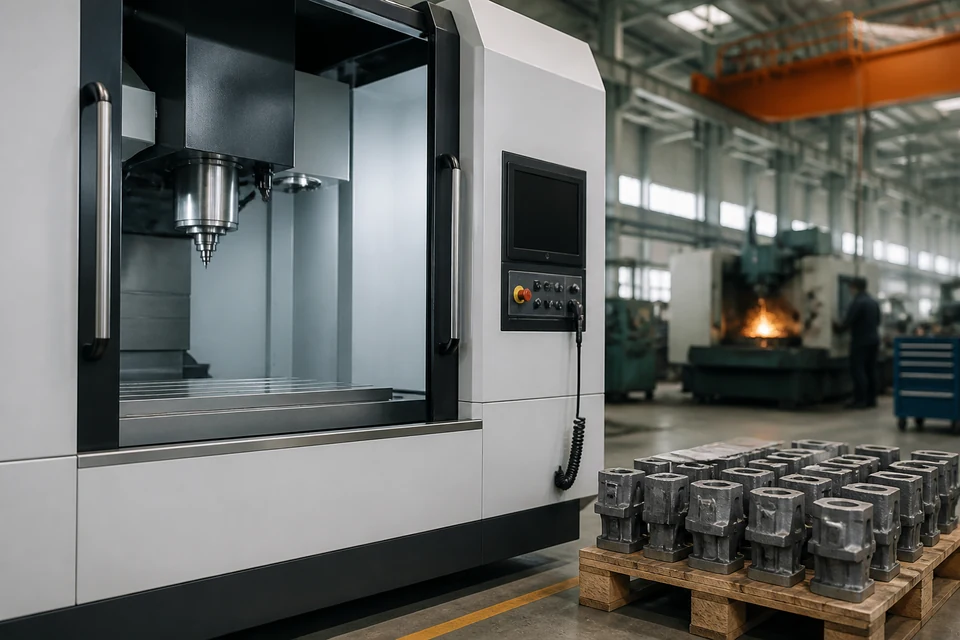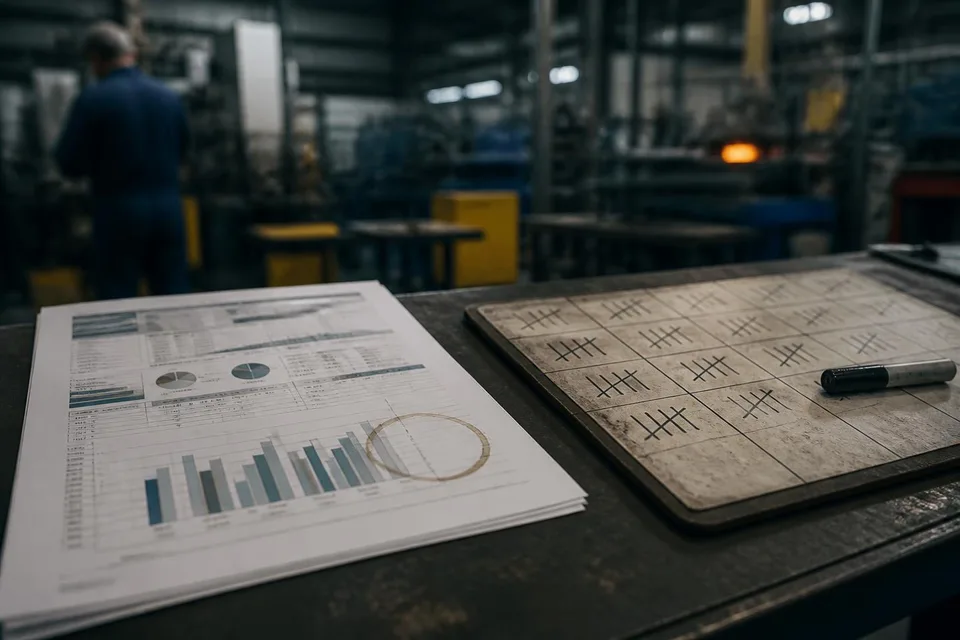

In almost every plant I walk into, KPIs are on display. OEE at the machine, delivery performance at the entrance to the hall, lead time in the monthly report. The boards are maintained, the charts are current. And yet in everyday work exactly what always happened keeps happening: the machine stands still, the team waits for material, the order goes out late.
That is not a contradiction. A KPI on its own changes no behaviour. It only changes behaviour when people understand it, when they can influence it and when a deviation leads to an action that they themselves are allowed to trigger. If one of those is missing, the KPI remains decoration.
In this article I take the three KPIs that hang most often in plants and show what they deliver in practice, where they are misused and how you can use them so that something moves in the hall and in the office.
Why KPIs so often move nothing
I see three causes that repeat themselves in plants. The first: the KPI is too far away from the action. A monthly delivery performance for the whole plant tells the shift leader nothing about what he should do differently today. He cannot influence it, so he ignores it.
The second: the KPI is used as a verdict, not as a tool. If a poor OEE in the meeting leads to the question of who is to blame, people quickly learn to make the number look better instead of solving the problem. Stoppages are booked as changeover time, rework runs outside the count. The KPI rises, the plant does not get better.
The third: no action follows. The number is read off, commented on, ticked off. Nobody asks what we are doing about it today. Without that question, every KPI is just a rear-view mirror. It shows what was, and changes nothing about what is coming.
OEE: the formula is simple, and so is the trap
Overall equipment effectiveness is made up of availability, performance and quality, multiplied together. That is generally known and quickly explained. The trap lies not in the formula but in the use.
OEE is an equipment KPI. It says how well a particular machine uses its planned time. It says nothing about whether that machine should be running at all. I have seen plants that clung to a high OEE and in doing so produced stock that nobody needed, because the machine was not allowed to stand still. That is overproduction, and overproduction is the worst waste, because it hides all the others.
This is how I use OEE so that it changes behaviour: only at the bottleneck, not everywhere. Broken down by loss type, so that the team can see whether changeovers, breakdowns or minor stoppages are the problem. And discussed daily with the question: which loss was the biggest yesterday, and what are we doing about it today? An OEE that appears as a single bar in the monthly report moves nothing. An OEE that is broken down into its losses at the board in the morning is a work order.
Lead time: the KPI that includes the office
Lead time measures how long an order takes from receipt to delivery. For me it is the most honest KPI in the plant, because it does not only reflect the hall. A large part of the lead time arises before the first part is processed: in order clarification, in production planning, in purchasing, in release loops.
An example: in a plant with several assembly lines, plant management was convinced that assembly was too slow. When we mapped the value stream from customer order to delivery, it turned out that the order spent the largest part of its time in order processing and in engineering release. Assembly was only a short section at the end. Until then, all improvement projects had targeted that short section.
For lead time to change behaviour, it has to be broken down into sections that someone is responsible for. Order processing needs its own lead time, production planning its own, manufacturing its own. Then each team can see where its orders are sitting, and then a board in the clerical office helps just as much as one on the line.
Delivery performance: the customer's KPI
Delivery performance is the KPI the customer feels. It answers the question of whether we keep what we promised. And that is exactly where its catch lies: the promise is often the problem, not the delivery.
I know plants in which sales promises dates that manufacturing can never meet, because nobody asked beforehand. Delivery performance falls, manufacturing is criticised, and the actual error lies at an interface that appears in no KPI. Anyone who wants to improve delivery performance therefore first has to look at the date promise: who promises, on what basis, with what feedback from planning?
For delivery performance to change behaviour, I recommend two things. First: look at every missed date individually, not just the rate. The causes are usually few and they repeat. Second: put the KPI up at the interfaces where dates are created, in other words between sales, planning and manufacturing, and not only at dispatch. Where the date is made, it also has to be visible.
From reading off to acting: the question that is missing
Whatever KPI hangs on the board, there is one question that makes the difference: what are we doing about it today? If that question is not asked in the shopfloor meeting, the meeting is a reporting round. If it is asked, it is a steering instrument.
For the question to be answerable, the teams need three things:
- The KPI has to sit at their level. Not the plant's delivery performance, but the on-time delivery of their orders this week.
- They have to be able to influence the KPI. If the loss arises from missing parts, the team needs a way to escalate that to purchasing, and an answer that comes back.
- They have to be allowed to act. A team that has to get every small change approved first stops making suggestions.
The third is a leadership question, not a KPI question. And this is the reason why I never introduce KPIs without leadership work. The best board is useless if the supervisor is not allowed to decide.
Fewer KPIs, more effect
Finally, a piece of advice that is uncomfortable: put up less. I see boards with twelve charts of which nobody looks at more than two. Every KPI that does not lead to an action dilutes the attention for those that do.
Choose a few KPIs per team that it understands, can influence and discusses daily. Check every few months whether they still trigger actions. If not, swap them or drop them. A KPI is not a monument. It is a tool, and tools that nobody uses do not belong on the wall.
In short
- A KPI only changes behaviour if the team understands it, can influence it and is allowed to act on it.
- OEE belongs at the bottleneck and has to be broken down into its losses, otherwise it leads to overproduction instead of improvement.
- Lead time starts at order receipt: the largest share often lies in the office, not in the hall.
- Delivery performance is decided at the date promise, which is why it belongs at the interface between sales, planning and manufacturing.
- Fewer KPIs, discussed daily with the question of what we are doing about them today, achieve more than full boards.
Frequently asked questions
Frequently asked questions
Which KPIs belong on a shopfloor board?
Few, and ones the team can influence at that point. The fields safety, quality, delivery performance and productivity have proven themselves, each with one KPI at team level. More important than the selection is that every deviation in the daily meeting leads to an action. A board with two KPIs that are lived is worth more than one with ten that are read off.
Why does our OEE rise without the plant getting better?
Usually because the KPI is used as a verdict instead of a tool. Then the teams learn to groom the number: stoppages are rebooked, rework runs outside the count, the machine produces stock so that it does not stand still. Check whether OEE is measured at the bottleneck and whether the loss types are visible. And take the question of blame out of the meeting.
How do I measure lead time in the office?
Exactly as in manufacturing: from the receipt of a transaction to its handover to the next step, separated into processing time and waiting time. In order processing, a date stamp at receipt and exit per station is often enough. You will see that waiting time makes up the largest part. That is exactly where standards, clear responsibilities and a board in the clerical office come in.