
Friday afternoon in order processing. The customer calls and asks about his delivery. It was promised for today. The clerk looks in the system, sees the order in assembly and says she will get back to him. Then she calls the production manager. He says the material only arrived on Wednesday. Purchasing says the order was only released the day before. Design says the drawing was stuck in the approval loop for three days. Everyone is right. The date is gone anyway.
I have traced this chain in many plants, from the customer call backwards to order receipt. Almost always the date was not lost in the hall. It disappeared in small portions in the weeks before, in in-trays, in approvals, in handovers between departments that cannot see each other.
So anyone who wants to improve delivery reliability does not have to make production faster. They have to make the stretch before production visible. That is what this article is about.
The date is promised before anyone knows what it costs
The first loss happens at the promise. Sales commits to a date because the customer wants it and because a no would jeopardise the order. The basis is a standard lead time that was set at some point and says nothing about current workload, material availability or design capacity.
That is no accusation against sales. They simply have no other information. If order processing cannot see at a glance how full the next few weeks are, only the standard figure remains. And the standard figure is too long in quiet times and too short in busy ones.
The point I explain to executive boards again and again: delivery reliability does not start with speed, but with honesty at the promise. A date that is a week later and is kept is worth more to the customer than one that is earlier and wobbles. Customers plan with dates. They can live with long dates, not with unreliable ones.
Where the days really disappear
When I trace an order backwards, I rarely find the lost time in one place. It is spread out:
- At order receipt: the order sits in an in-tray until someone enters it. Incomplete details go back to sales, the customer is asked, it takes time.
- In design or production planning: the order waits because another one was more urgent. A query to the customer stays unanswered for days, and nobody chases it.
- In purchasing: the order is batched to save shipping costs, or waits for a signature that only one person may give.
- In goods receipt: the material is there, but not booked in. Production does not know.
- Between departments: every handover costs at least a day, because nobody actively makes the handover. One person files it, the other collects it when they get round to it.
Add up these points and you get a picture that has little to do with the actual manufacturing time. The order sits far longer than it is worked on. That is the lead time, and it is the true enemy of delivery reliability.
Why production still gets the blame
Production stands at the end of the chain. When the date bursts, it is the one currently working on the order. It is visible, measurable and in the executive board's report. The days in the design department's in-tray appear in no report.
This has a bitter consequence: production begins to protect itself. It builds in buffers, reports dates back later, keeps capacity free for the rush orders it knows will come. As a result the standard lead time gets even longer, sales deviates from it even more often, and the number of rush orders rises. Mura, the unevenness, and muri, the overburden, do not originate in the hall. They only become visible there.
Anyone who wants to break this cycle has to stop measuring the date at the end and start tracking it along the way.
An example from special-purpose machine building
A mid-sized machine builder with customer-specific orders had a delivery reliability that gave the executive board sleepless nights. The suspicion fell on assembly, which was regarded as the bottleneck. They were considering building another assembly hall.
Before the decision was taken, we recorded a few typical orders from receipt to delivery, with every idle day and every handover. Assembly really was full. But it was full because the orders arrived too late and in waves. Design had no fixed sequence, worked on demand and pushed fully planned orders ahead of itself for days until sales applied pressure. Then several arrived in assembly at the same time.
The solution was not a new hall. It was a visible order sequence across all departments, a short daily coordination meeting between sales, design and assembly, and one rule: no order may sit for longer than a day without feedback. Assembly received its work more evenly, and the dates held far more often. The hall was never built.
Four things that actually improve delivery reliability
The measures that have worked most reliably for me are unspectacular:
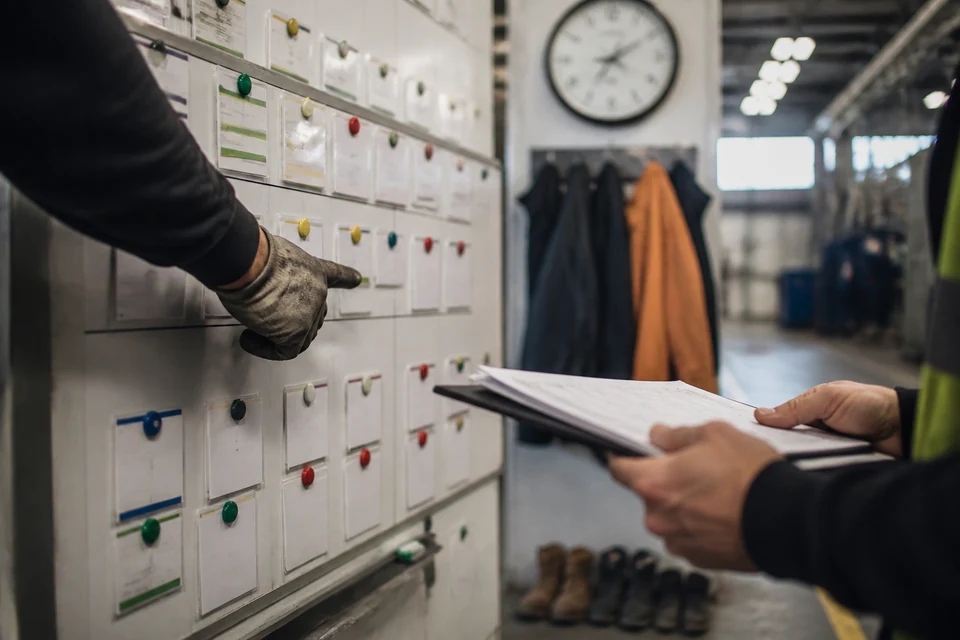
First: date commitments based on real workload. Sales must be able to see how full the next weeks are in design, purchasing and production before committing. That can be a simple board. What matters is that it is up to date.
Second: an order sequence that applies to everyone. Not every department with its own priority, but one list derived from the customer date and visible to all.
Third: handovers with responsibility. Whoever passes an order on remains responsible until the next person has accepted it. Filing is not a handover.
Fourth: a short daily conversation about the orders that are wobbling. Not about all of them, only the critical ones. That is the office version of the shop floor meeting, and it works just as well.
None of these measures needs new software. All of them need the willingness to see the order as a whole rather than as a sequence of departmental tasks.
What you can check yourself in the coming week
Take an order that was recently late and trace it backwards. For each station, write down when it arrived, when it was worked on and when it moved on. You will find idle times that nobody knows about, because nobody has asked.
Then ask a second question: who knew at what point that the date could no longer be kept? Almost always that moment came long before the customer call. Someone saw it and did not report it, because there was no place to do so.
These two questions show you where your delivery reliability really originates. And they show you that the answer rarely lies in the hall.
In short
- The date is usually lost before production, in in-trays, approvals and handovers.
- Delivery reliability starts with an honest promise. Customers can cope with long dates, not unreliable ones.
- Production gets the blame because it stands at the end and is measurable. That protects the causes.
- One sequence for all, active handovers, a daily conversation about wobbling orders.
- Trace a late order backwards. Nobody knows the idle times, because nobody asks.
Frequently asked questions
Frequently asked questions
Should we simply extend the standard lead time so that we can keep it?
That is only half the answer. A longer commitment helps in the short term, but changes nothing about the idle times and makes you slower in the market. It is better to tie the commitment to the real workload and at the same time shorten the idle times between departments. Then the dates become more honest and the lead time shorter. Both together is delivery reliability.
Do we need a new ERP system for order tracking?
In most cases, no. The existing system usually knows where an order is. It just does not know how long it has been sitting there and who is currently waiting for it. That can be made visible with a board, a list or a simple whiteboard. If that works for a few months, you know exactly what a system needs to be able to do. Before that, you are buying software for a process you do not yet understand.
Who should be responsible for delivery reliability, if not production?
The order as a whole needs one responsible person who keeps an eye on it from receipt to delivery. In many plants that is nobody, because each department only sees its own part. Whether this role sits in order processing, in internal sales or in a dedicated order control function depends on the plant. What matters is that it exists and actively tracks the handovers.