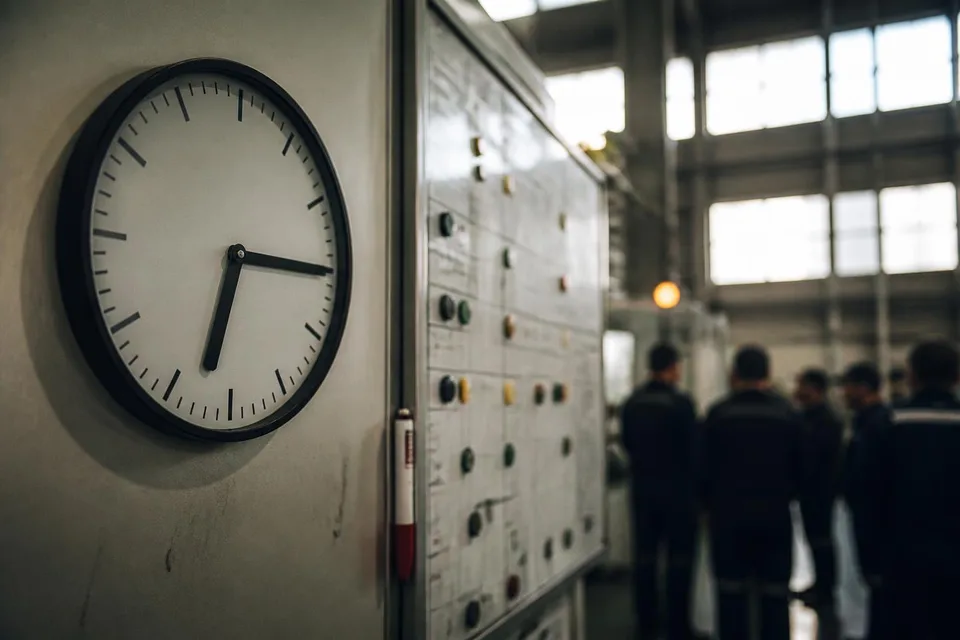

It is just before six. The night shift is packing up, the early shift is getting changed. At the line, two shift leaders meet, one tired, one not quite awake yet. "All okay?" "Yes, number three played up, but it is running again." Handshake, done. Two hours later number three stands still again, and nobody on the early shift knows what was done to it during the night.
I have seen this scene in plants of all sizes, in corporate sites with four shifts just as in family businesses with two. The shift handover is the moment in which the knowledge of an entire shift is supposed to be passed on in a few minutes. And almost everywhere it is the least designed moment of the day.
Yet this is where it is decided whether the new shift starts with a clear picture or with whatever it has to find out for itself. In this article I show what is really lost in a handover, how a good handover is structured and why it is a leadership issue and not a question of forms.
What is lost between the shifts
A shift produces not only parts, but also knowledge. Which machine has been running at its limit for hours. Which order was put back because of missing parts. Which fix helped with the breakdown in the afternoon and which did not. Who from the team had to leave early today and why the station was unmanned at the end.
This knowledge sits in the heads of the people who are just going home. If it is not handed over, the next shift has to acquire it anew, by trial and error, by asking around or by having the same breakdown again.
What typically disappears:
- Faults that were "somehow" fixed without the cause being clear.
- Temporary fixes that someone installed and nobody knows about.
- Orders put back and the reason for it.
- Quality anomalies that have not yet led to a hold, but should be watched.
- Commitments to maintenance, logistics or planning that the next shift would have to keep.
Each of these points costs the next shift time, often hours. And the handover takes minutes. Hardly any investment in the plant has a better ratio.
Why the handshake is not enough
The informal exchange between two shift leaders has one advantage: it is fast and personal. But it has three weaknesses that make it fail in everyday life.
It depends on two people. If one of them is absent, on a break or dealing with a fault at that moment, it does not take place. It depends on memory. Anyone reporting from memory after eight hours of night shift forgets the most important thing, because it happened six hours ago. And it has no place. What was said afterwards exists only in two heads. The employee at the station learns nothing of it if his shift leader does not carry it further.
There is a second reflex that fails just as badly: the handover form. A sheet with many fields, filled in at the end of the shift and put in a folder. I have leafed through such folders. They are completely filled in and never read. The form fulfils a regulation, but no purpose. The handover has become a document instead of a conversation.
How a good handover is structured
A handover that holds is short, has a fixed place and always follows the same sequence. The pattern that has proved itself in my projects has four components.
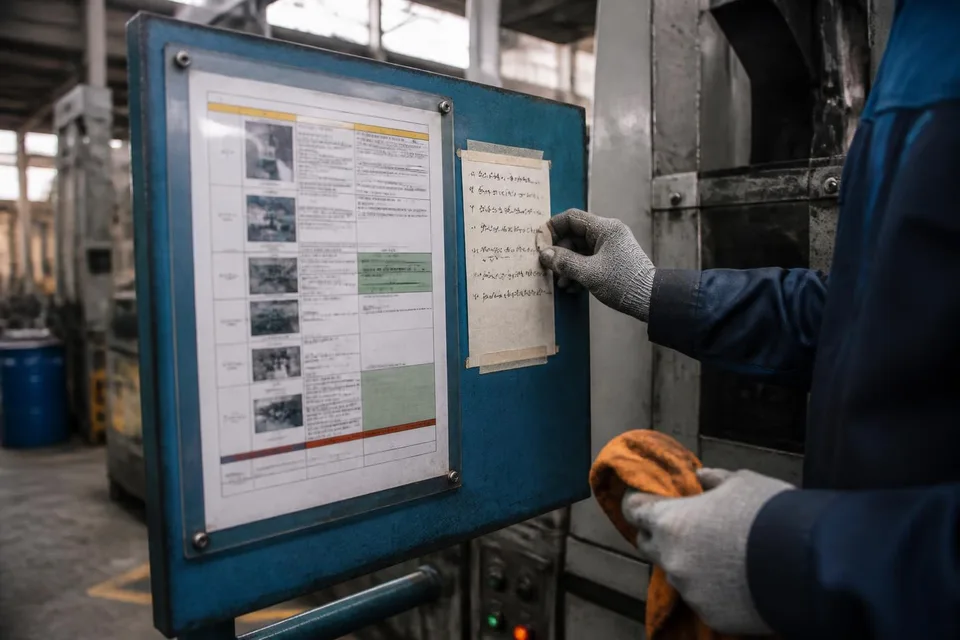
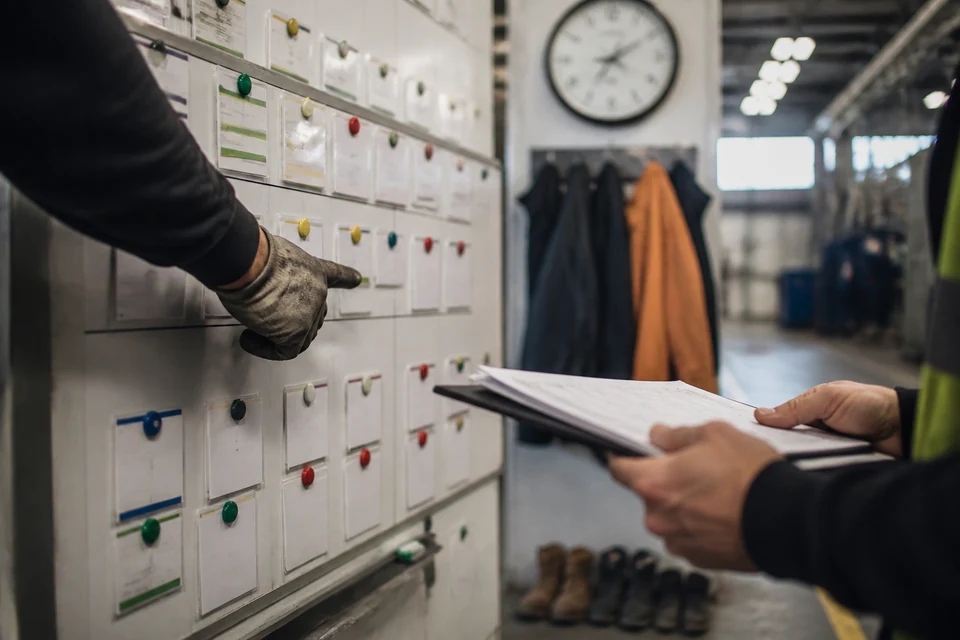
The place: a board at the line, visible to all, not in the foreman's office. It shows the current status per machine and per order, with a traffic light or cards, so simple that it can be grasped in a minute.
The sequence: first safety, then quality, then machines, then orders, then staff. Always the same, so that nothing is forgotten and the listeners know what comes next.
The participants: both shift leaders and the people who work at the stations concerned. Not the whole shift, but those for whom the information is relevant. The handover at the board takes a few minutes, after which the pairs at each station go briefly to their machine.
The addendum: the handover is prepared during the shift, not at the end. Whoever fixes a fault hangs the card on the board immediately. Whoever puts an order back writes the reason next to it. At the end of the shift nothing is reconstructed any more, only what is already hanging there is explained.
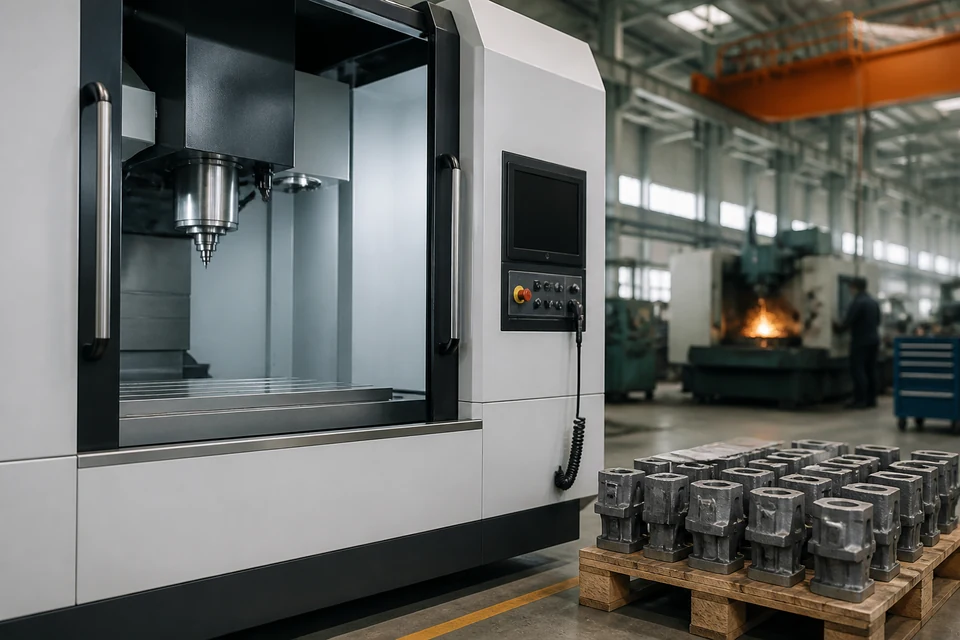
A plant with several machining lines introduced exactly this after the early shift had repeatedly been unaware of the night shift's temporary fixes. The decisive step was not the board, but the rule that every temporary fix is marked there immediately. Since then the early shift no longer begins with a search.
The overlapping handover and its price
Many plants pay for an overlap between shifts so that there is time for the handover. That is the right idea, and it only works if this time is actually used for the handover. In practice it is often eaten up by the changing room, the coffee machine and the fault of the moment. The overlap is then a cost block with no return.
If you have an overlap, you should know what happens in it. Stand next to the board at a shift change once and observe without intervening. What you see is usually more honest than any report.
And if you have no overlap, you need the board all the more. Then it is the only medium in which the outgoing shift can tell the incoming one anything. The rule of documenting during the shift then becomes a condition, not a recommendation.
Why the handover is a leadership issue
A handover only works if the outgoing shift has an interest in the incoming one starting well. That is not a given. In some plants there is a silent competition between the shifts: who made more parts, who got the difficult orders, who leaves the machine in what condition. In this climate, the handover is a place where nobody gives anything away.
Plant management decides on this climate, whether it wants to or not. If shift KPIs are compared against each other, if the night shift's fault is charged to the early shift, if temporary fixes bring only trouble instead of recognition for reporting them, then there is no handover. There is just wrapping up.
So it is part of a good handover that leadership visibly values it. The plant manager who occasionally stands at the board at six and listens says more with that than any instruction. And whoever briefly picks up the previous day's handover in the shop floor meeting makes it part of the system, not a duty on the sidelines.
Where to start
Choose a line where the shift changes create noticeable friction. Observe two or three handovers without intervening. Note what is said, what is asked and what the new shift had to find out for itself in the first hour.
Then sit down with the shift leaders and let them design the board and the sequence themselves. The draft does not have to be perfect. It has to come from the people who will use it. After two weeks, look together at what is missing and what is superfluous.
The handover is the smallest process in the plant with the greatest leverage. It costs minutes and saves hours, every day, in every shift. And it shows the workforce something that no programme can show: that the work of one shift counts for the other.
In short
- A shift also produces knowledge. What is lost at the handover, the next shift has to acquire again at a high price.
- Handshake and form fail alike: one without place and memory, the other without readers.
- Good handovers have a board at the line, a fixed sequence, and are prepared during the shift.
- An overlap only pays off if it is really used for the handover. Stand next to it once.
- Whether there is a handover or just wrapping up is decided by the climate between the shifts, and leadership sets that.
Frequently asked questions
Frequently asked questions
Is a digital handover in the system enough instead of a board?
A digital handover log can supplement the board, but does not replace the conversation on the spot. The strength of the board is that it hangs at the line, is visible to everyone and can be grasped in a minute. A system entry is read when someone opens it. If you want to work digitally, make sure the status remains visible at the line, for instance on a screen, and that the handover still takes place in person.
What if the shifts do not overlap and the handover is only possible in writing?
Then the board becomes the only handover medium, and the rule of documenting during the shift becomes mandatory. Every fault, every temporary fix, every order put back goes on the board immediately, not at the end of the shift. In addition, it helps if the shift leaders have a brief phone call or leave a voice note, for what cannot be written on a board. What matters is that the incoming shift begins its first minutes at the board, not at the machine.
How do I get the shifts to hand over honestly instead of hiding problems?
By rewarding reporting and not concealment. If a shift reports a temporary fix and receives recognition for it, because the next shift does not walk into the trap as a result, then reporting happens. If the same report leads to accusations, there will be silence next time. Do not compare shifts against each other, but look at the line as a whole. And as a manager, occasionally stand at the board yourself, that shows you are serious.