01
Production planning is overturned every day. Rush orders, missing parts and machine breakdowns dictate the schedule, not the other way round.

process optimisation
Process optimisation is not a project you do once. It is a plant's ability to see, measure and improve its own processes. I help you build this ability, in manufacturing, in production planning and in the office processes before and after it. With tools I applied myself in the plant for 13 years.
When plant managers call me, they usually have no shortage of ideas, but a shortage of impact.
Process optimisation means changing a process so that it delivers the same or a better result with less effort, less time and fewer errors. That sounds simple and fails in practice because of three things: people optimise individual stations instead of the flow, they optimise without measurement, and they optimise without the people who carry out the process every day.
My process optimisation consulting therefore always starts with the overall process. For production, that means value stream mapping, bottleneck analysis and a waste audit. For production planning, it means looking at planning logic, batch sizes, changeover times and the control principle (push or pull) together, because production optimisation without planning only shifts the symptoms. For office processes, it means uncovering media discontinuities, duplicate data entry and approval loops and streamlining the handovers.
Efficiency gains are the result, not the goal. The goal is a process that your team understands, masters and develops further on its own.
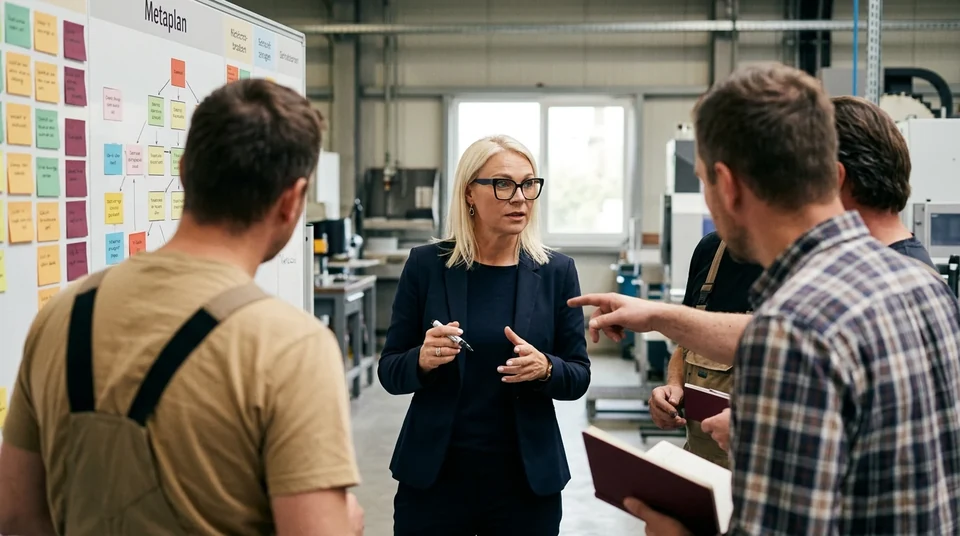

Before I change anything, I want to understand where your plant stands. For that I use my Lean and Change Maturity Check with seven assessment areas, separately for shop floor and office.
The one with the greatest influence on delivery reliability, lead time or cost, not the one that shouts loudest.
On site, with the team: value stream, process times, idle times, error rates, changeover times, planning rules. Where needed, with process mining from your system data.
Ishikawa, 5 Why, A3. Treat the cause, not the symptom.
New process standards, SMED for changeover times, Kanban for inventories, adapted planning rules, streamlined office handovers. First in a pilot area, then across the board.
Key figures on the shop floor board, regular communication routines, standards in writing, audits after four to eight weeks.
Results you can see at the line and in the figures:
Process analysis with current state, waste balance and proof of the bottleneck.
Action plan with effort, benefit, owners and deadlines, prioritised by impact.
New process standards and work instructions, developed with the employees.
Key figures and a board at which the process is followed up daily.
Recommendation on automation potential and tool support where it pays off.
A team that has learned the method and optimises the next process itself.
Intro call
You describe your starting point, I tell you openly whether and how I can help.

Frequently asked questions
Process optimisation is the systematic improvement of a process with the aim of making it faster, cheaper, more stable or better in quality. It starts by recording the current state, looks for the causes of waste and errors, and then designs a target process that is tested, measured and standardised. In production it is mostly about lead time, inventories, changeover times and scrap; in the office about idle times, handovers and media discontinuities. The difference from a one-off measure is the systematic approach: measure, change, check, standardise.
Because a plant's biggest reserves are not in new machines but in the processes in between. An order that is in the building for three weeks and worked on for four hours loses 99 percent of its time in the process. Process optimisation wins this time back: shorter delivery times, less tied-up capital, more output with the same workforce. There is a second reason too: anyone who optimises processes makes them describable and learnable. The plant depends less on individual knowledge holders.
For analysis: value stream mapping, process recording with a swimlane diagram, spaghetti diagram, OEE analysis, process mining from system data. For root cause analysis: Ishikawa diagram, 5 Why, A3 report. For improvement: 5S, SMED for changeover time reduction, Kanban and supermarkets for inventories, TPM for equipment availability, Poka Yoke against errors, standard work. For anchoring: PDCA, shop floor management, process audits. Which method comes first is decided by the findings, not by the catalogue.
First measure where time is lost: waiting times in front of machines, search times, changeover times, rework, transport routes. Then tackle the biggest loss. In many plants that is not machine speed but the flow between the stations. Concrete levers are smaller batches with shorter changeover times, a tidy workplace according to 5S, pull control instead of producing ahead, and a daily shop floor meeting that makes deviations visible immediately. Efficiency gains are the result of these steps, not a goal you can decree.
With the SMED method (Single Minute Exchange of Dies). In the first step we film or observe a complete changeover and separate internal changeover steps (machine stopped) from external ones (machine running). In the second step we move everything that can be done externally to the outside: laying out tools, staging material, loading programmes. In the third step we shorten the remaining internal steps with quick-release clamps, standard positions and clear changeover sequences. Changeover time reduction is the prerequisite for smaller batches and thus for shorter lead times.
Process management is the permanent organisation of a company's processes: process map, defined process owners, documentation, key figures and regular review. Process optimisation is the concrete improvement of a single process. One is the framework, the other the work within it. A plant without process management optimises selectively and loses the results again. A plant with process management but without optimisation administers its processes without making them better. I offer both and usually recommend starting with the optimisation of a core process and developing the framework from there.
I bill on a time-and-materials basis at a day rate or as a fixed-scope package, transparently and monthly. What a project costs depends on how many processes we tackle and how much your team takes on itself. A single changeover workshop is something different from several months of support for production planning. We clarify the scope and the proposal in a no-obligation initial consultation. I give you concrete amounts there, not on the website.
Very closely. The best line is of little use if planning feeds it with large batches, constant rescheduling and the wrong priorities. Conversely, planning can only be as good as the changeover times and lead times it works with. That is why I look at both together: which planning rules apply, how batch sizes are determined, whether control is by push or pull, how rush orders are handled? The biggest lever for production often lies in planning, not in the hall.
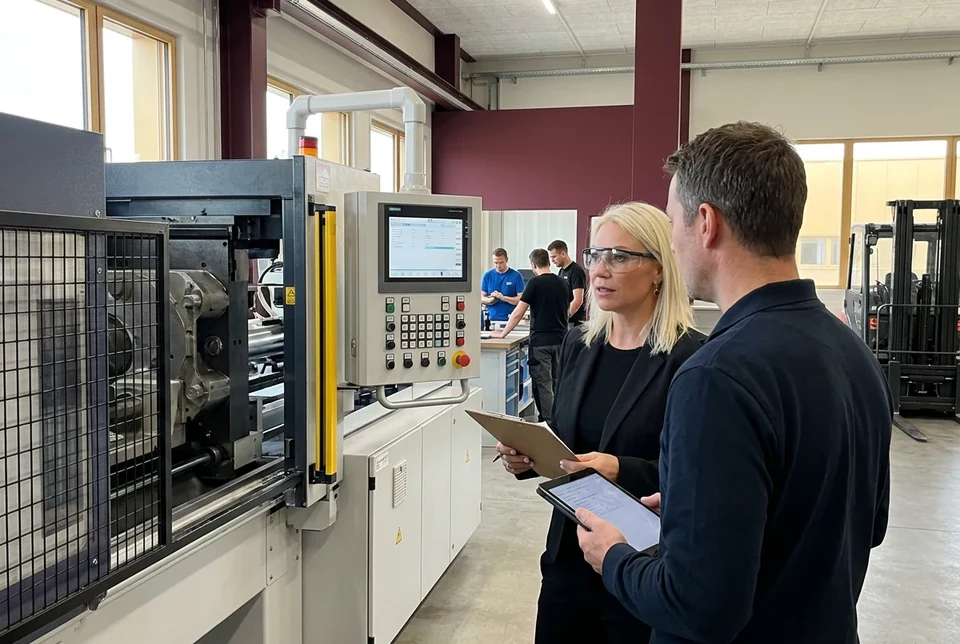
45 minutes, no obligation. Tell me the process that costs you the most time.