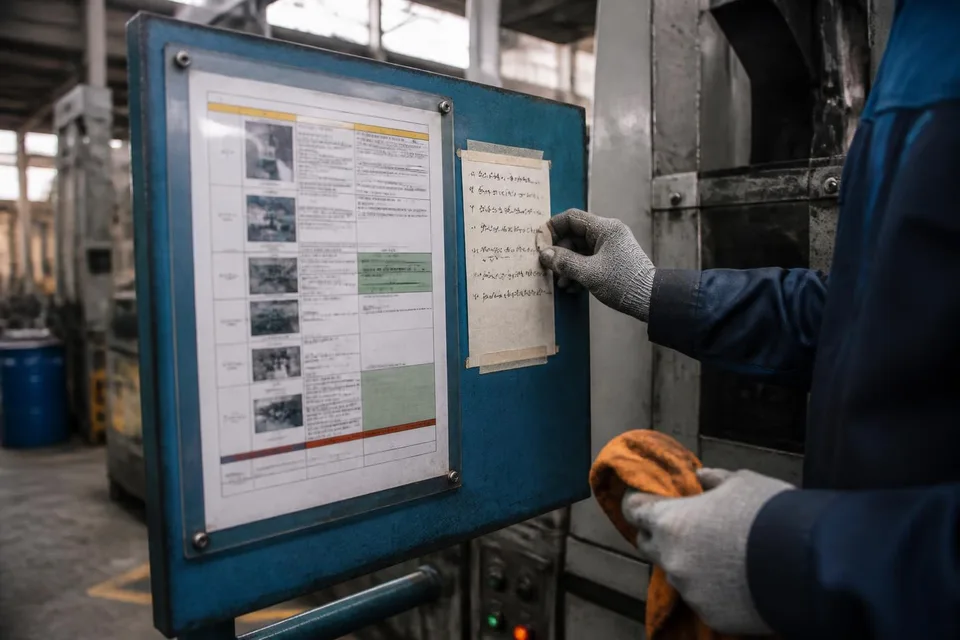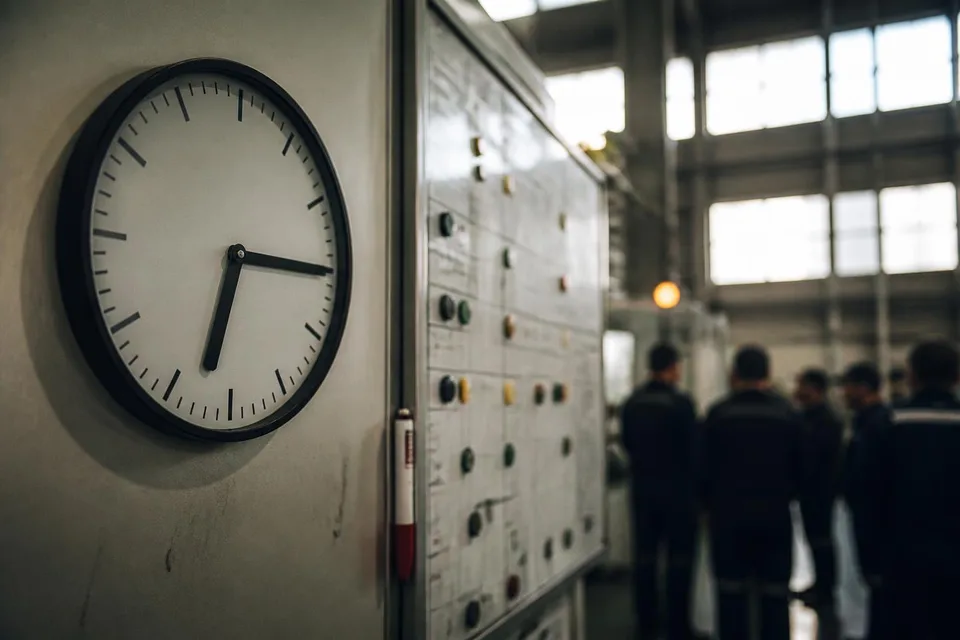

In almost every plant I visit, boards are up. White boards with KPIs, traffic lights, action lists. Plant management shows them with pride. Then I stand there in the morning, and the meeting lasts forty minutes, three people talk, the others look at the floor, and the action list is the same as a month ago.
The shopfloor meeting is the heart of every shopfloor management system. It is the place where deviations become visible daily and turn into actions. When it works, it carries the whole improvement system. When it does not work, the board is wall decoration with whiteboard markers.
In this article I describe what a shopfloor meeting in a quarter of an hour looks like that moves something. Which KPIs belong on it, which do not, and which mistakes I see again and again, in group-owned plants as well as small operations.
What the meeting is for, and what it is not for
The daily shopfloor meeting has exactly one purpose: recognise deviations from the standard and decide who does what about them by when. Everything else belongs elsewhere.
It is not an information event. Whoever wants to announce news from the executive team does so in a separate round. It is not a problem-solving session. Whoever wants to clarify the cause of a breakdown does that afterwards with those affected, not with the whole team in front of the board. And it is not a report upwards. The plant manager who stands there listens and asks questions. He does not receive reports.
If you take these three boundaries seriously, the quarter of an hour is suddenly long enough. Most overlong meetings are overlong because they are three meetings in one.
The format in a quarter of an hour
A fixed format is more important than a beautiful board. It gives security, and it prevents the loudest participant from setting the agenda. This is the format I build with teams:
- Start on time, standing, at the board. Whoever arrives late joins in. Nothing is repeated.
- Safety first: were there incidents, near misses, open hazards? One sentence per point.
- KPIs from the previous day: each KPI is stated by its owner, target and actual, green or red. If green, move on. If red, one sentence on the deviation, not a lecture.
- Actions: open items are queried, done or due. New deviations get a name and a date, nothing more.
- Outlook for today: what is special? Staff, material, customer deadline, maintenance.
- Close: who carries what to the next level? End.
The facilitator keeps the time and the sequence. In a plant with several assembly lines we introduced a simple rule: whoever talks for longer than a minute is politely interrupted and the item goes on the "after the meeting" list. After two weeks the rule was no longer needed.
Which KPIs belong on the board
The most frequent question: which KPIs? The honest answer: fewer than you think, and different ones from what controlling suggests.
The board is for KPIs that the team influenced yesterday and can influence again today. Typically one each from the fields of safety, quality, delivery performance, output and people. For instance: accidents and near misses. Defects or rework. Orders on plan or late. Piece count or equipment availability against target. Attendance or qualification level.
What does not belong on the board: monthly figures, financial KPIs, group KPIs and everything the team only takes note of. An OEE figure from last month triggers no action on a Tuesday morning. An unplanned downtime from yesterday does.
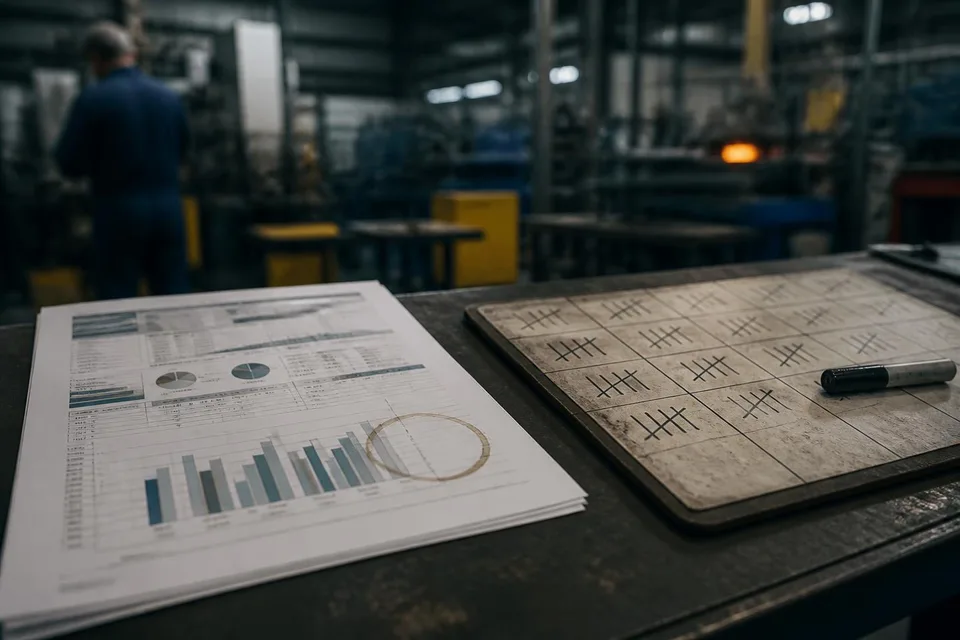
Two rules have proved themselves. First: every KPI has a target, a colour and an owner from the team who enters it themselves. By hand, with a pen. Second: if a KPI is green for weeks, it comes off the board or gets a more demanding target. A board full of green traffic lights is not a success, but a sign that the targets are too comfortable.
The action list: where most boards die
The KPIs are the trigger. The action list is the result. And it is the place where I most often see that a shopfloor management system exists only formally.
Typical pictures: the list has thirty entries, half of them older than a quarter. Under "owner" there is a department instead of a name. Under "due date" it says "ongoing". Or the list is empty, because nobody enters anything any more, since nothing happens anyway.
A working action list is short. Every entry has a name, a date and a sentence describing how you recognise that it is done. What the team can solve itself stays on the board. What needs maintenance, purchasing or production planning goes to the next level with a name and a date and comes back with an answer. That is the core of the cascade: every level solves what it can solve and passes the rest upwards, not the other way round.
And: completed actions are celebrated, briefly but visibly. A team that only sees every morning what is still open loses heart.
The typical mistakes, and how to avoid them
After many years at many boards, I see the same patterns every time:
- The boss facilitates. Then everyone reports to him, and the meeting becomes a report. Better: a team member facilitates, the manager asks questions.
- The board is filled in by the office. Printed charts from the ERP look clean and belong to nobody. Handwriting creates commitment.
- There is discussion. Root cause analysis does not belong in front of the board. Name it briefly, set a date, clarify afterwards.
- Red is punished. As soon as a red traffic light triggers uncomfortable questions about blame, everything turns green. Red is information, not an accusation.
- It is cancelled. "Too much going on today" is the beginning of the end. It is precisely on hectic days that the quarter of an hour is needed.
- There is no next level. The team reports deviations, and nobody picks them up. After a few weeks the team reports nothing more.
In the order processing of a plant where we transferred the principle to the office, the decisive mistake was a different one: the board hung in the corridor, the team sat in three offices. Nobody passed by. After moving it to the wall between the offices, the meeting ran by itself.
What plant management has to contribute
A shopfloor meeting only holds if leadership carries it. Not through attendance at every round, but through three things.
First: close the cascade. If the team reports deviations upwards, a meeting has to exist up there that picks them up and returns answers. Otherwise the team is alone.
Second: questions instead of instructions. When plant management is present, it asks: what was missing yesterday? What do you need from me? It does not say what is to be done. That shifts responsibility into the team, where it belongs.
Third: check regularly. A short look at the board on every walk through the hall: are the entries current? Is the action list moving? These questions are part of every gemba walk. A board nobody looks at is no longer maintained after a few weeks. A board that plant management checks every week lives.
In short
- The shopfloor meeting has one purpose: recognise deviations and trigger actions with a name and a date.
- Fixed format beats beautiful board: safety, KPIs, actions, outlook, end. Standing, on time.
- Only KPIs the team influenced yesterday and can influence today. Handwritten, with an owner.
- The action list is short, has names and dates, and the next level answers.
- Red is information, not an accusation. Whoever punishes red gets a board full of dishonest green.
Frequently asked questions
Frequently asked questions
Who should facilitate the shopfloor meeting?
Ideally a member of the team, not the manager. If the boss facilitates, the meeting becomes a report, and everyone reports to him instead of talking to each other. The role can rotate, for instance weekly, so that several people master the format. The manager stands by, listens and asks questions. That is unfamiliar at first, but makes the difference between a board that belongs to the boss and one that belongs to the team.
Does a shopfloor meeting also work in the office?
Yes, the principle is the same: daily, short, standing, at a board, with KPIs the team influences itself. In order processing those are, for example, open orders by age, queries to customers or waiting times in the in-tray. What matters is that the board hangs where the team actually works, and that the KPIs come from the previous day's work. Digital boards can replace that if they are large and visible, not on the team leader's laptop.
What to do if the meeting falls asleep after a few months?
That is the normal case, not the exception, and it almost always has one of three causes: the KPIs are all green and no longer trigger anything, the actions fizzle out at the next level, or leadership no longer looks. Examine these three points honestly, together with the team. Usually it is enough to sharpen the targets, repair the cascade and reintroduce plant management's gemba walk. A restart with a new board, by contrast, rarely helps.