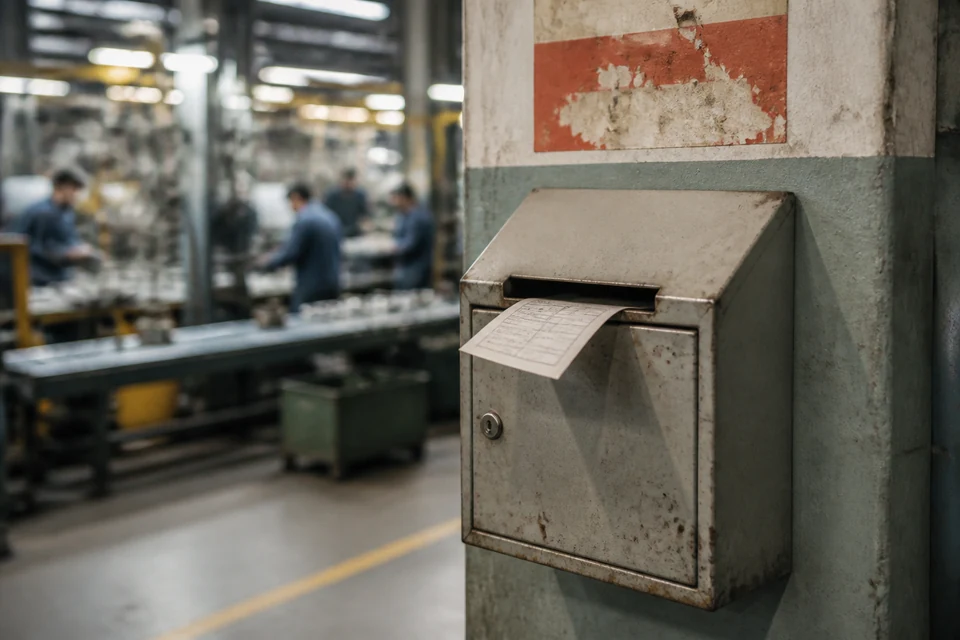

Almost every plant has one. A box made of sheet metal or Perspex on a pillar, above it a poster calling for participation. Next to it a rack of forms. Sometimes the box is empty, because nobody posts anything any more. Sometimes it is full, which is worse, because then someone has not emptied it.
In many plants I have asked what happens to the suggestions. The most honest answer came from a foreman: "They go to a committee. What it does, I don't know. I submitted two years ago and never heard anything." The man had dozens more ideas after that. He kept them to himself.
That is the real tragedy of the classic suggestion scheme. It is not just ineffective. It trains the people who know the process best to keep their knowledge to themselves. In this article I show why that is and what works instead.
The suggestion box is a queue without an end
Look at the suggestion route as a process for a moment, the way you would look at a production order. A form is filled in, posted, collected, passed on to a committee, discussed there in a meeting, evaluated, handed to a specialist department for review, reported back, decided, perhaps rewarded, at some point implemented. Every step has waiting time. Most steps have no deadline.
In lean vocabulary this is a value stream consisting almost entirely of idle time. The idea itself takes minutes. The route takes months. And at no point does the person who had the idea see where it currently sits.
Then there is the evaluation. Committees tend to assess ideas rather than try them. They ask about cost-effectiveness, side effects, responsibility. A small improvement at the workstation rarely survives this review, because its benefit is too small to pay off on paper and too concrete to be judged by people who do not work there.
What good ideas really need
An improvement idea from the line or from the office has three needs. It wants to be heard, it wants to be tried quickly, and it wants the person who had it to see the result.
Being heard means: someone who can make decisions takes note of it the same day. Not a form, but a person. Being tried quickly means: if the idea is small, it is tried this week, without an application. If it is big, it gets a date and a name that sees to it. Seeing the result means: the person finds out whether it worked, and if not, why.
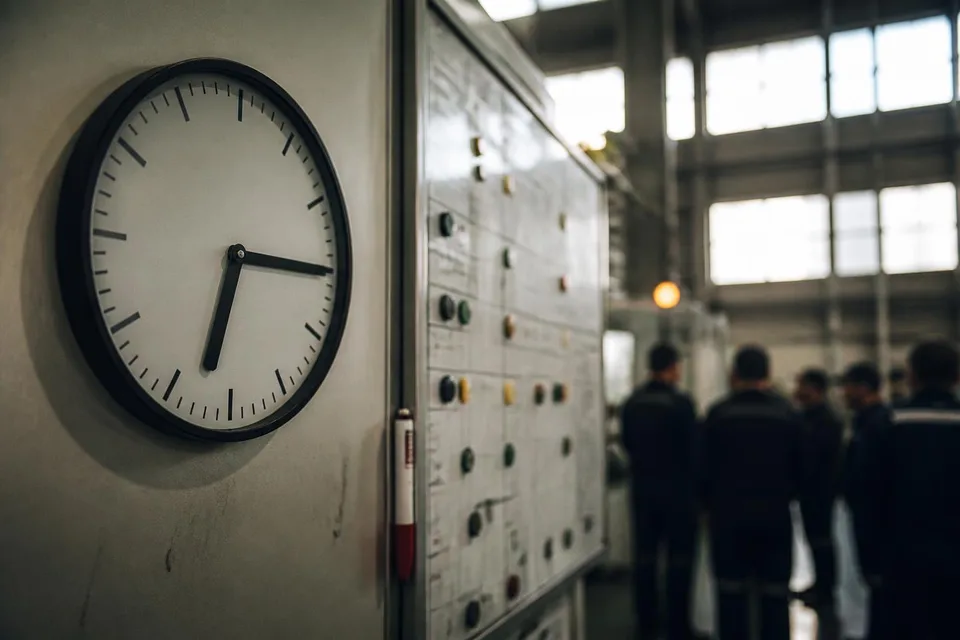
A suggestion box does none of that. But a simple board at the workstation does, with three columns: idea, in progress, done. Plus a short fixed moment every week when the team stands in front of it with its manager.
How an assembly area got rid of its suggestion box
A plant with several assembly lines had an award-winning suggestion scheme that hardly anyone used. Plant management wanted to revive it and was thinking about higher rewards. Instead, we hung an idea board next to the shopfloor board in one area and agreed the rule: every idea that the team can implement itself is implemented without asking. Everything else, the team leader takes within the week to someone who can decide, and reports the answer back.
In the first weeks, ideas came in that nobody on the committee would ever have seen. A holder for a tool that kept falling down. A different place for the waste bin so that the walk is shorter. A change in the sequence when packing. Every single one was small. Together they changed the workstation, and above all they changed the attitude. People saw that their idea was on the wall on Tuesday and implemented by Friday.
The suggestion box stayed on the pillar for a few more months. Then someone unscrewed it. Nobody needed it any more.
The role of the manager
Continuous improvement is not a department and not a system. It is a leadership task that happens every day or not at all. The team leader who asks on the walk-round what was annoying today gets more ideas than any suggestion box. So does the department head in the office who asks in the weekly round which transaction took unnecessarily long this week.
That demands something that many plants have not provided for: time. A manager who runs from meeting to meeting has no moment for the setter's idea. And it demands attitude. Taking the idea seriously, even if it is incomplete. Not explaining why it will not work, but asking how it could be tried.
The PDCA cycle according to Deming contains exactly that: plan, do, check, act. The suggestion box stops at plan. The board at the workstation runs the whole circle.
Rewards and other misunderstandings
Many suggestion systems are built around the reward. That has consequences that hardly anyone intended.
- Small ideas are not submitted, because the effort is not worth it. But it is precisely the small ideas that improve everyday work.
- Ideas are held back until they are big enough for a reward. Improvement becomes a collecting game.
- The evaluation becomes a point of dispute. Who decides how much an idea is worth, and why does the colleague get more?
- Ideas that arose in the team get a single submitter. That creates envy instead of collaboration.
I am not against recognition. But the most effective recognition for an idea is that it is implemented and that the person sees it. If you want to keep rewards, then for the team, not for the individual, and for implementing, not for submitting.
What you can change this week
You do not have to abolish the suggestion scheme to get started. Choose one area, on the shop floor or in the office. Hang up a simple board. Agree that the team leader stands in front of it every week. Define what the team may decide itself, and make that scope generous.
Then, after a few weeks, look at what is on the wall. You will see ideas whose underlying problems you did not know existed. And you will see people who start telling you again what they notice. That is the moment improvement begins in the plant. Not in a box, but in a conversation.
In short
- The suggestion box is a value stream made of idle time: minutes for the idea, months for the route, no result for the submitter.
- Ideas need three things: to be heard, to be tried quickly, to see the result. A board at the workstation delivers that.
- What the team can implement itself is implemented without an application. The scope for that should be generous.
- Improvement is a daily leadership task, not a system. It needs time and the question: what was annoying today?
- The best recognition is visible implementation. Rewards, if at all, for the team and for implementing.
Frequently asked questions
Frequently asked questions
What do we do with the suggestions still sitting in the old system?
Go through them once, together with the team leaders, and sort honestly: implement, reject with a reason, or transfer to the new board. Every person who submitted something gets an answer, even if it is years old. That is the first proof that something is changing. Then close the old route.
How do we prevent the board from becoming a complaints wall?
Complaints are unfinished ideas. If someone writes that the material always arrives late, the question is: what could we change? In the weekly round, the team leader turns complaints into suggestions, together with the team. If after a few weeks the board shows only complaints, that is important information about the area, not a malfunction of the board.
How do we handle ideas that cost money or affect other departments?
They stay on the board, get a name and a date. The team leader takes them to the next level, say the area meeting or plant management, and reports the decision back. What matters is that these ideas do not disappear into a committee, but that the person sees where their idea currently sits and when an answer is coming.