
Do you know the sheet? It leans in the corner of the meeting room, rolled up, with colourful sticky notes. It was the result of a good day. The leadership team was open, production and administration really listened to each other for the first time, the action list ran to two pages. Everyone said thank you. And then Monday came, and with it the day-to-day business.
I have facilitated more than a hundred workshops and training sessions, and I say this in all honesty: the workshop itself is almost never the problem. It fails beforehand, because nobody clarified what is allowed to happen afterwards. And it fails afterwards, because the workshop was conceived as an event and not as a beginning.
This article is about the question of why workshops so often have no consequences, and about what you as the commissioning party can do so that a good day turns into a change.
Why workshops feel good and still move nothing
A workshop is a protected space. The hierarchy is relaxed for a day, the day-to-day business is locked out, someone from outside facilitates. In this space, people say things they otherwise do not say, and they agree on things they otherwise do not agree on. That is the value of the format.
It is also its trap. What was agreed in the protected space has to be implemented in the unprotected everyday routine. There the hierarchy applies again, there the day-to-day business presses, there nobody is from outside. The agreement that seemed self-evident in the workshop suddenly seems risky on Monday.
Add to that the confusion of experience with result. Feedback forms measure how the day was. They do not measure what it changed. A workshop can have been wonderful for everyone involved and still have achieved nothing. The good mood is then the result, and it lasts as long as the memory of the day.
The causes lie before the workshop
When I talk to commissioning parties about a workshop, I ask three questions above all. The answers decide whether it is worthwhile.
What is allowed to be different afterwards? Surprisingly often the answer is unclear. The workshop is supposed to "improve collaboration" or "bring the team on board". Those are wishes, not results. If it is not clear what may change in the workflow, in the roles or in the decisions, nothing will change.
Who decides on the results? A workshop whose measures subsequently have to pass through three committees produces proposals, not change. The participants notice this quickly and work accordingly without commitment. If the leadership that can decide is not in the room or has not delegated its decisions to the team in advance, the day is an exercise.
What is the actual problem? The wish for a workshop is often a symptom. Two areas are in conflict, so a workshop is supposed to improve the relationship. The actual problem is an unclear interface that is not even on the workshop agenda. Then the participants end up being friendlier with each other, and the interface remains unclear.
An example: the action list that nobody owned
In a plant with several production areas, plant management had commissioned a two-day workshop to improve collaboration between planning, production and logistics. The workshop was a success. The three areas had said things to each other that had gone unspoken for years, and had drawn up a list with many measures.
Three months later, none of them had been implemented. Not out of malice. Every measure had a name next to it, but the name was only that of the person who had contributed the idea. Whether they were allowed to implement it, with what resources and by when, had never been clarified. Plant management had not followed up after the workshop, because it assumed the list would work itself off.
What helped then was not a second workshop. It was a short meeting in which the list was cut down to three measures that plant management itself released, each with one accountable person and a fixed slot in the weekly department heads' meeting. Two of them were implemented. The third failed at an interface, and precisely that failure provided the topic for the next round. That is what progress looks like. Not as a full list, but as visible movement.
What must be different during the workshop
If the preconditions are clarified beforehand, one thing above all decides the impact during the workshop: whether accountability is assigned at the end, or only ideas are collected.
A few rules have proved themselves for me here:
- Less is more. Three measures with an owner and a deadline are worth more than twenty without. The rest is noted and explicitly put back.
- Every measure has exactly one person. Not a department, not a circle. And this person has to say what they need in order to start.
- The first step is set in the room. Not the whole implementation, but the one thing that happens in the first week. That forces concreteness.
- The place of follow-up is named. In which existing meeting will the measures be discussed? Introducing a new meeting for this is usually the beginning of the end.
- At the end, leadership says what it releases and what it does not. Honestly, in the room, not in an email a week later.
The last point is uncomfortable and therefore decisive. People can live with the fact that not everything is released. What they cannot live with is the experience that everything was received kindly and then vanished in silence.
The first four weeks afterwards
The impact of a workshop is decided in the weeks afterwards, and there it is leadership that is needed, not facilitation.
In the first week, the first step of every measure must have visibly happened. Not the result, but the beginning. A manager who does not follow up in this week signals that it was not important. One who follows up signals the opposite, and to everyone, not only to the person asked.
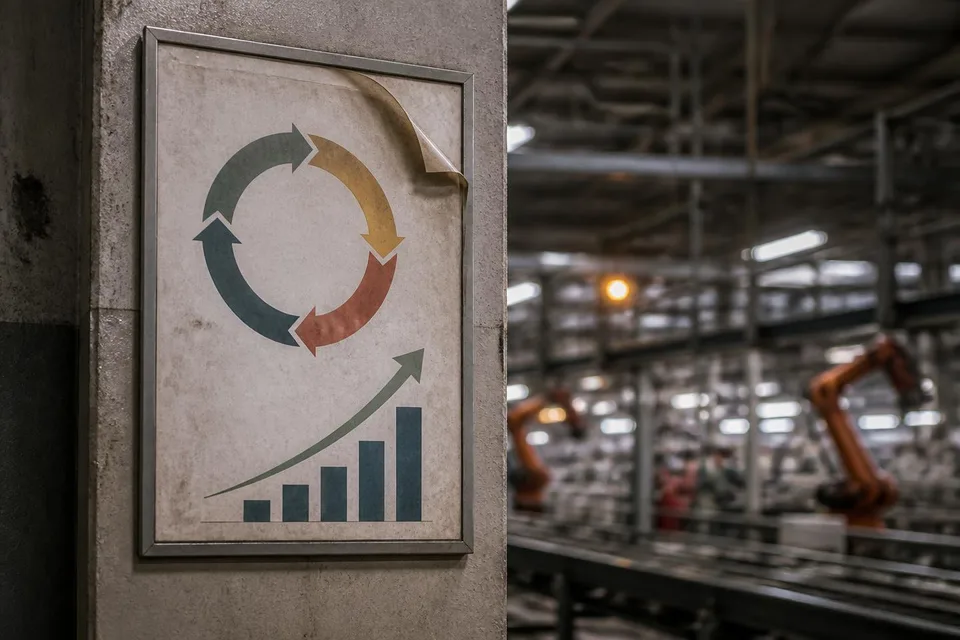
In the following weeks, the measures belong on the agenda of the meeting that was named for them. Briefly, always in the same pattern: where does it stand, what is missing, what does leadership decide today? That is the PDCA cycle in its simplest form, and it is the only thing that keeps a workshop result alive.
And if a measure fails, that is not a failure but information. Why? What was missing? This answer is often more valuable than the measure itself, because it points to the actual obstacle. A workshop whose results are followed up in this way changes something. One whose list sits in the cupboard was a day.
What you should ask an external facilitator
If you bring in someone from outside for a workshop, pay attention to the questions this person asks you before they agree. If they only ask about the date, the participants and the room, you get a day. If they ask what is allowed to be different afterwards, who decides and where the results will be followed up, you get a chance of change.
And be honest with yourself if you do not have the answers. Then the workshop may not yet be the right step. Perhaps what is needed first is a conversation in the leadership team about what is actually supposed to change. That is less spectacular than a day with moderation cards. But it is the precondition for the day achieving anything.
In short
- The workshop rarely fails in the workshop. It fails beforehand on unclear goals and afterwards on missing follow-up.
- Feedback forms measure the experience, not the result. Good mood is no proof of impact.
- Clarify in advance: what is allowed to be different afterwards, who decides, what is the actual problem?
- Three measures, each with one person, a first step and a place of follow-up, beat twenty without.
- Leadership decides the impact: through honest release in the room and following up in the first week.
Frequently asked questions
Frequently asked questions
Should we hold a second workshop after one that had no consequences?
In most cases not, at least not immediately. A second workshop with the same preconditions produces the same result, and the participants become even less committed, because they experienced it the first time. Instead, take the existing list, cut it down to a few measures, give each one an owner and a slot in an existing meeting. Once that is running, a next workshop is worthwhile, because people then know that something happens.
Does the executive board have to be present at the workshop?
Not necessarily the whole time, but its decision-making authority must be in the room. Either the leadership is there itself and releases at the end, or it has clearly delegated in advance what the team is allowed to decide. A workshop whose results are subsequently submitted for approval seems non-binding, and that is exactly how the participants will work. If leadership is present, it should listen and only speak at the end, otherwise the room aligns itself to it.
How many measures are realistic?
Few, and preferably fewer than you think. I advise as many as there are people who can actually carry them alongside the day-to-day business. Usually that is a handful. Everything else is visibly put back, so that the people who contributed the ideas know their idea is not lost but waiting. A short list that is worked off builds trust. A long list that is left lying destroys it.