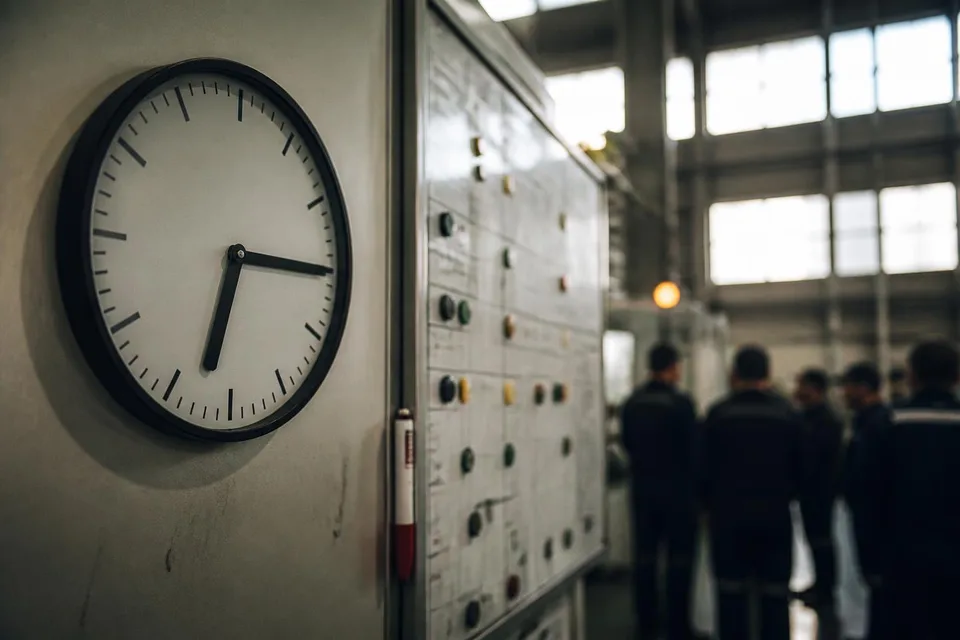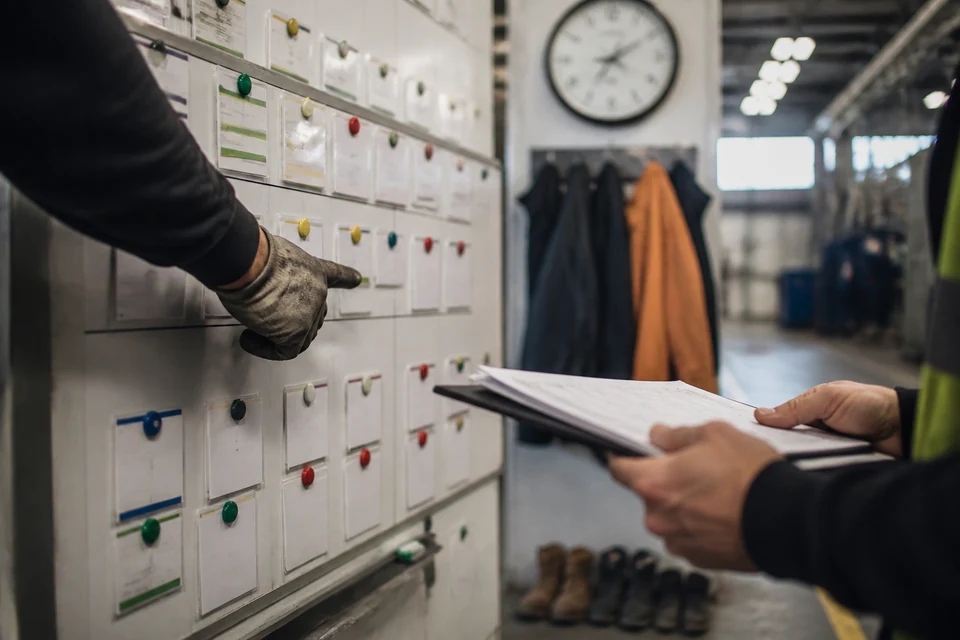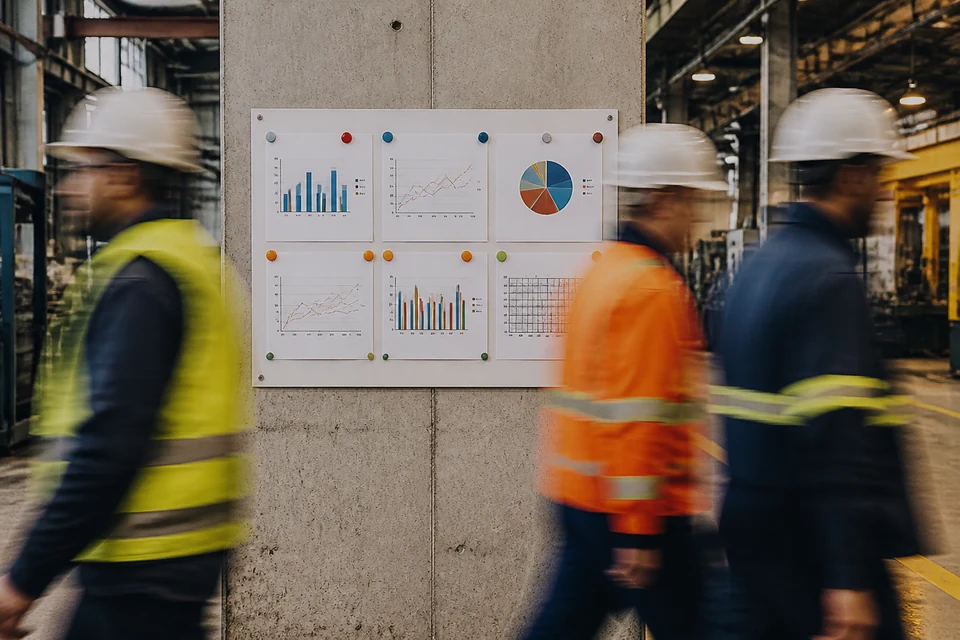

The board is a showpiece. Neatly labelled, current printouts, coloured magnets, the charts run from left to right. Someone from production control updates it every Monday. And then you stand next to it for half an hour and count how many people look at it. None do.
I see this scene in corporate plants and in mid-sized companies, on the shop floor and in the office, where the board is a screen on which the processing status blinks. The numbers are correct. The presentation is good. Yet nothing happens, because the board has become wallpaper.
The usual reaction is to improve the board. Different KPIs, bigger type, a screen instead of paper. That does not help, because the problem is not on the board. It lies in what is missing around it.
The board is a news medium, not a working tool
Ask yourself honestly what your board was made for. In most plants the answer is: to inform. People should know how things are going. That is a well-meant intention, and it is the reason the board does not work.
Information that triggers no action is ignored. That is not a character flaw of the workforce, but a sensible reaction. If the number for delivery reliability is red and nothing about my day changes as a result, why should I look at it? The board competes with everything at the workstation that demands attention, and loses, because it wants nothing from me.
A board that works is something else. It is the place where a decision is made. It shows what deviates from the plan today, and it shows who is taking care of it by when. That way it wants something, and then people look.
Four reasons nobody looks
When I stand in front of an abandoned board, I almost always find one or more of these reasons:
- The numbers belong to someone else. They are maintained by production control or by controlling, not by the team. What you do not write yourself, you do not read.
- The numbers are too old. A weekly evaluation from Monday tells the early shift on Thursday nothing about its day. To act, you need numbers from yesterday or from the last shift.
- The numbers are too far away. Plant utilisation, total costs, customer satisfaction. Important for management, but with no connection to what a line or a clerk can influence.
- There is no moment. Nobody stands in front of it at a fixed time. The board has no appointment, so it has no audience.
Each of these points can be fixed. None of them is fixed by a prettier board.
How things changed in a plant with three shifts
A plant had a large printed overview at every line with OEE, scrap, delivery reliability and sickness absence, prepared monthly by controlling. Plant management was proud of it. When asked, the line leaders could not tell me a single one of the numbers.
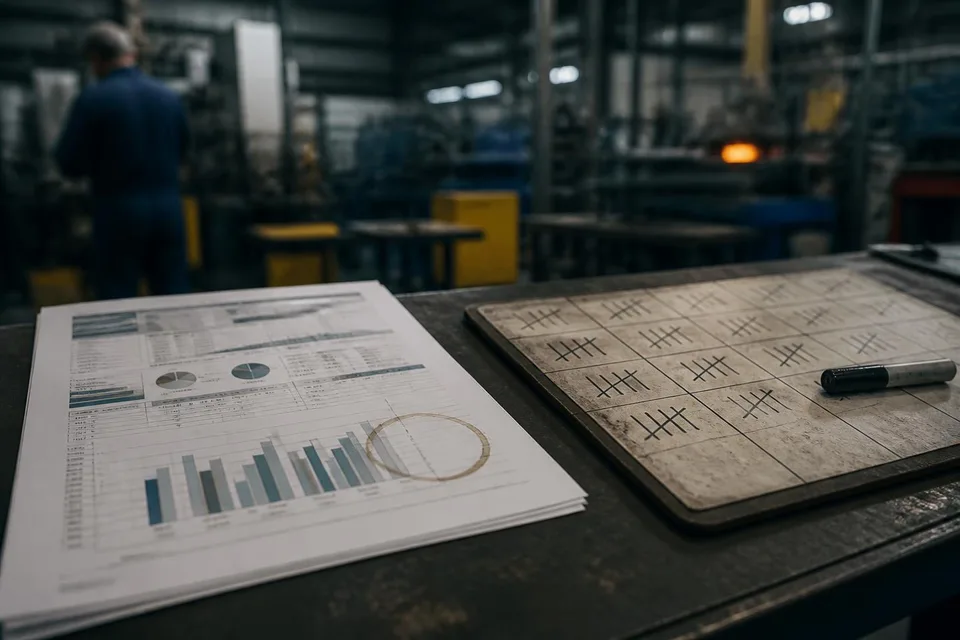
We took down the printed boards and replaced them with a whiteboard surface on which the shift itself enters: actual versus target units per hour, with a tally mark, with a pen. Next to it a column for disruptions with the reason and one for open actions with name and date. At the start of the shift, team and shift leader stand in front of it for a few minutes and go through the deviations only.
After two weeks the board no longer looked pretty. It was written on, corrected, marked with question marks. But everyone on the line knew where the shift stood yesterday and what has to be different today. Controlling's big KPIs still existed, for the management round. They had just been given a different place, the one where they belong.
The right number for the right level
KPIs have addressees. OEE is a good number for production management, which decides where to invest. For the person at the machine it is abstract. What they can influence is the units per hour, the changeover time, the number of disruptions on their equipment. Those are the numbers that belong on their board.
The same in the office. The lead time of an order across all departments is the department head's number. The clerks need: how many transactions are with me today, how many of them longer than agreed, and which are missing information. That can be shown on a board or a screen, and it triggers something, because the person can change it.
Hoshin kanri describes exactly this cascade: management's goals are translated at every level into measures that can be influenced there. A board that shows the same numbers at all levels is not a cascade. It is a copy.
What has to stand around the board
A board only works with three things that do not hang on the wall.
A fixed appointment: short, daily, always at the same time, in the same place, standing up. The shopfloor meeting is exactly that. Without the appointment there is no reason to look.
A manager who asks rather than explains. Whoever stands in front of the board and presents the numbers turns it back into a news medium. Whoever asks why the deviation arose and what we are doing today turns it into a working tool.
And an action column that is lived. Every deviation gets a name and a date. The next day, what came of it is checked. If the same open points have been sitting there for weeks, the team knows that the board achieves nothing, and stops looking again. The action column is the place where the board lives or dies.
A test for your board
Go to one of your boards tomorrow and ask three questions. Who entered the numbers on it? When was the last moment a team stood in front of it? Which action listed there was completed this week?
If the answers are: controlling, don't know, none, then you have wallpaper. That is not an accusation, but a finding. The good news is that the solution costs little. It consists of a pen, an appointment and a manager who asks questions. Everything else is decoration.
In short
- A board that only informs is ignored. A board where decisions are made gets looked at.
- Numbers the team enters itself get read. Numbers from controlling get overlooked.
- Every level needs its own number: influenceable, current, close to the workstation. Copies passed downwards do not work.
- Without a fixed appointment the board has no audience. Short, daily, standing up, with a manager who asks.
- The action column decides: if nothing gets completed there, the board dies.
Frequently asked questions
Frequently asked questions
Should we switch to digital screens instead of whiteboards?
Only once the board works as a working tool. A screen solves none of the problems that turn a board into wallpaper, and it takes away the team's ability to enter things themselves. Once appointment, questions and actions are lived, a screen can make data maintenance easier. Before that, it is just more expensive wallpaper.
How many KPIs belong on a board at the line?
As few as the team can influence and needs daily. In practice that is usually one quantity figure, one quality figure and an overview of disruptions, plus the actions. Everything the team cannot change belongs on the board of the next level up. A board that wants to be complete does not get read.
What if the shift leaders have no time for a daily meeting at the board?
Then that is the first action. In most plants a short meeting at the start of the shift saves more time than it costs, because disruptions are discussed earlier and duplicated work is avoided. Start with one line, keep the meeting very short and limited to deviations only, and let the shift leaders experience for themselves what changes.