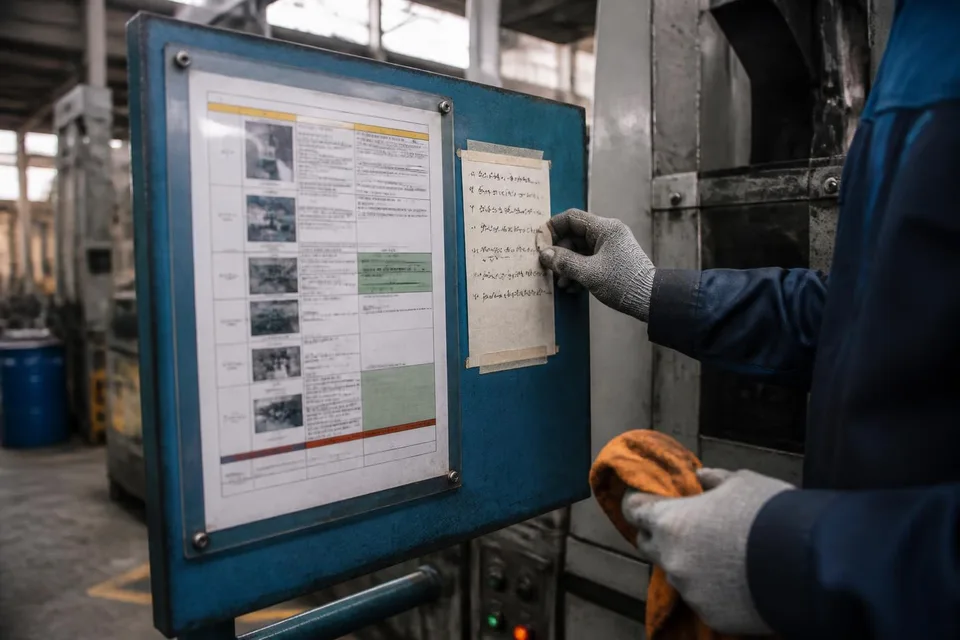

You know the picture: in the lead plant the shopfloor meetings run, the boards are maintained, the standards hang on the line and are lived. Then the order comes from headquarters to roll the whole thing out to the other sites. A manual is produced, templates are sent out, a trainer travels around. And a year later the same boards hang in the other plants, only empty.
I have experienced this situation several times, in corporate plants and in mid-sized groups with several sites. The pattern is always similar: what was laboriously worked out at the first site is handed to the next ones as a finished solution. And that is precisely the copying error.
In this article I describe why transferring lean standards between sites fails so often, what can actually be transferred and what a rollout looks like that holds at every plant.
Why copying does not work
A standard that is alive at one site is the result of a process. People saw a problem, argued about it, built a solution, adapted it and at some point made it their own. The paper on the wall is only the tip of that. The rest, the shared understanding, the story behind it, the small adjustments, sits in people's heads.
If you send the paper to another site, only the tip arrives. The second plant receives a solution to a problem it never experienced in that form, in a shape that fits machines, shift models and people it does not have. The people on site sense that immediately. They rarely say it out loud, but they do what people do with instructions from elsewhere: they put them up and work around them.
On top of that comes a second layer. Between sites there is almost always a history. The lead plant is seen as headquarters' favourite, the others feel like second choice. A standard that comes from the lead plant is therefore never just a standard. It is also a message: do it like them. And that message creates resistance, regardless of how good the standard is.
What can actually be transferred
The question is not whether you should transfer standards. Of course you should. The question is at which level. I distinguish three levels:
- Principles: every deviation is made visible daily. Problems are solved where they arise. Every standard has an owner. This level is the same everywhere and it is not negotiable.
- Minimum requirements: every plant has a daily shopfloor meeting with fixed KPIs for safety, quality, delivery performance and productivity. Every plant follows up on deviations. What the board looks like is open.
- Design: columns, colours, time of day, facilitation, escalation paths. That belongs to the site.
The most common mistake in a rollout is to confuse the third level with the first. Then people argue about the colour of the magnets while nobody has understood the principle. Anyone who separates the levels cleanly gives each plant what is necessary and leaves it the rest. That is not a loss of control. It is the prerequisite for the standard becoming the site's own.
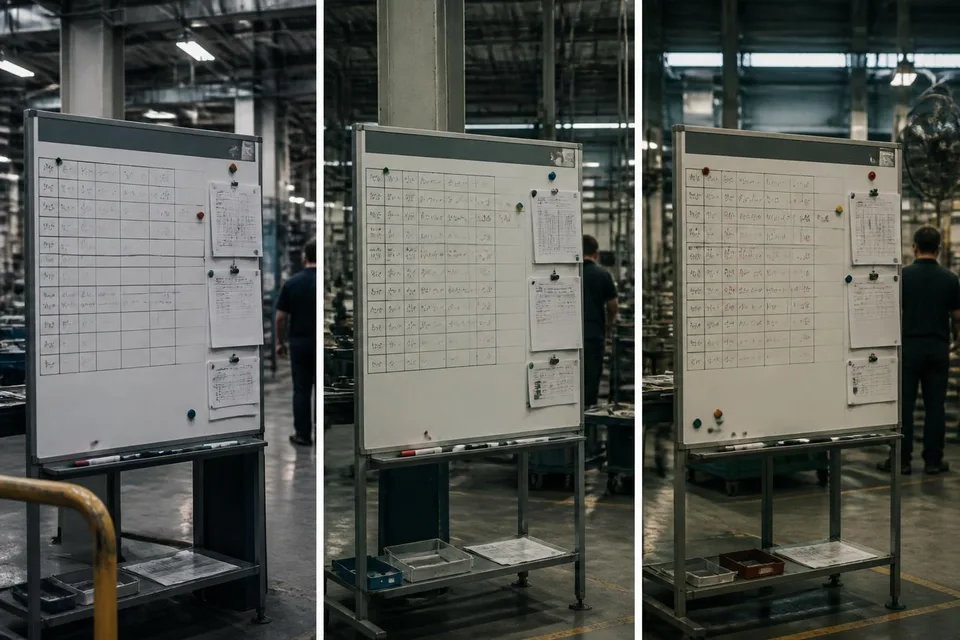
An example: the shopfloor board that looked different three times
In a group of companies with several plants in different countries, the largest plant had developed a shopfloor board that worked very well. Headquarters wanted to introduce it at all sites and had the board printed in several languages.
At a smaller site with one-off production it did not fit. The KPI of units per shift made no sense at a batch size of one, the line for line stoppages stayed empty because there was no line. After a few weeks the board stood in the corner.
The restart went differently. The local plant management received the principles and minimum requirements, not the template. In a workshop with supervisors and production planning, their own board emerged: instead of units, on-time delivery per order was at the centre, instead of line stoppages, missing parts. It looked completely different from the one in the lead plant. And it fulfilled the same principles. Headquarters could read both boards side by side because the logic was the same. That is what I mean by a standard without the copying error.
The role of headquarters: set the frame, do not execute
In rollouts across sites, the role of headquarters or the lead plant is decisive, and it is almost always set up wrongly. Either headquarters prescribes everything and creates resistance. Or it leaves everything to the sites and gets a patchwork that nobody can compare any more.
The task of headquarters is a different one: it defines the principles and the minimum requirements, and does so together with representatives of the sites, not over their heads. It provides people who help with the build-up without bringing the solution with them. And it ensures exchange between the plants, so that the sites learn from each other and not only from the lead plant.
This last point is underestimated. If a small plant finds a better solution for material supply than the lead plant, that has to become visible. Otherwise the hierarchy between the sites remains, and with it the resistance. I have had good experiences with regular plant visits in which supervisors and team leaders look at another plant, not the plant managers. That is where learning happens, because people meet as equals.
Lateral leadership: when you cannot give the sites orders
Anyone responsible for a lean rollout across several plants in most cases has no disciplinary authority over the sites. The plant managers report to someone else, have their own goals and their own priorities. I know this role from my own experience, and it is more demanding than any line function.
What works in this role is not pressure via headquarters, but benefit for the site. Every plant manager has a problem that keeps them awake at night: delivery performance, quality costs, staff shortages. If the rollout starts at exactly that problem, the plant manager becomes an ally. If it arrives as an additional reporting obligation, they become a brake.
That is why I start at every site with the same question: what would help you most here? And I build the entry point around the answer. The standard then comes not as a directive but as a solution to a problem the site itself has named.
How you can tell it holds
Whether lean has arrived at a site, you do not see in the manual and not in the number of boards. You see it in a few things:
- The plant changes its standards itself, without asking headquarters, and reports the change.
- Deviations are named in the meeting, including uncomfortable ones, and nobody justifies themselves for them.
- Supervisors and team leaders can explain why a standard is the way it is, not just that it is.
- Other sites ask this plant for advice, not only the lead plant.
If you see these signs, you can let go of the rollout. If you do not see them, no further audit will help. Then this site still lacks something of its own, and that only emerges through work with the people on the ground.
In short
- A living standard is the result of a process; anyone who only sends the paper transfers the tip, not the substance.
- Principles and minimum requirements are not negotiable; the design belongs to the site.
- Headquarters sets the frame together with the plants and organises learning between the sites, including away from the lead plant.
- Without authority, only benefit works: the rollout has to start at the problem the plant manager names themselves.
- Lean has arrived when a plant develops its standards further itself and others ask it for advice.
Frequently asked questions
Frequently asked questions
How much freedom should sites have in designing standards?
As much as possible, as long as principles and minimum requirements are met. Whether a board has three or five columns, whether the meeting takes place in the morning or at the shift change, the site decides. What is not negotiable: that deviations become visible daily, that every standard has an owner and that the KPIs remain readable across the plants. You have to name this separation clearly beforehand.
Should the lead plant lead the rollout at the other sites?
As a source of knowledge yes, as a superior no. If people from the lead plant instruct the other sites, the impression quickly arises that it is about conforming to the lead plant. Better is a neutral role, internal or external, that conveys principles and helps the site build its own solution. The lead plant can then serve as a place to visit and a conversation partner, without supplying the template.
What to do if a site openly opposes the rollout?
First find out why. Usually there is a history behind it: earlier programmes that fizzled out, the feeling of being treated as second choice, or simply an acute problem that ties up all their energy. That problem is where I start. When the site experiences that the lean methods solve its own issue, the attitude turns. Pressure from headquarters does not speed that up, it prolongs it.