
Every year the same ritual: the management team withdraws, formulates goals, presents them in January. The slides are good. And then everyday life arrives. A major customer escalates, a machine breaks down, a key employee resigns. By March hardly anyone remembers what was said in January. In December you discover that half the goals never really got started.
At the same time, you know it can be done differently. You have heard of hoshin kanri, perhaps seen it in a corporate plant. And you have seen what comes with it there: X-matrices, review cascades, a staff department that maintains the whole thing. A mid-sized plant cannot carry that. So it stays with the slides.
I want to show you that the essence of hoshin kanri is not the bureaucracy but a way of thinking that can be put into practice with modest means. Fewer goals, genuine dialogue, monthly follow-up. That is enough to bring annual goals all the way to the line.
What hoshin kanri is really about
Hoshin kanri comes from Japanese industry and roughly translates as compass-needle management. The basic idea is simple: a company cannot improve everything at once. So it chooses a few breakthrough goals that make the biggest difference and aligns all levels to them. Everything else continues as daily business, but without the ambition of moving everything at the same time.
The second core element is the dialogue between levels, known in lean terminology as catchball. Leadership throws a goal, the next level catches it, checks what it can contribute and what it needs to do so, and throws its answer back. Only when both sides agree is the goal settled. That is what distinguishes hoshin from the classic goal cascade, in which goals are simply passed down.
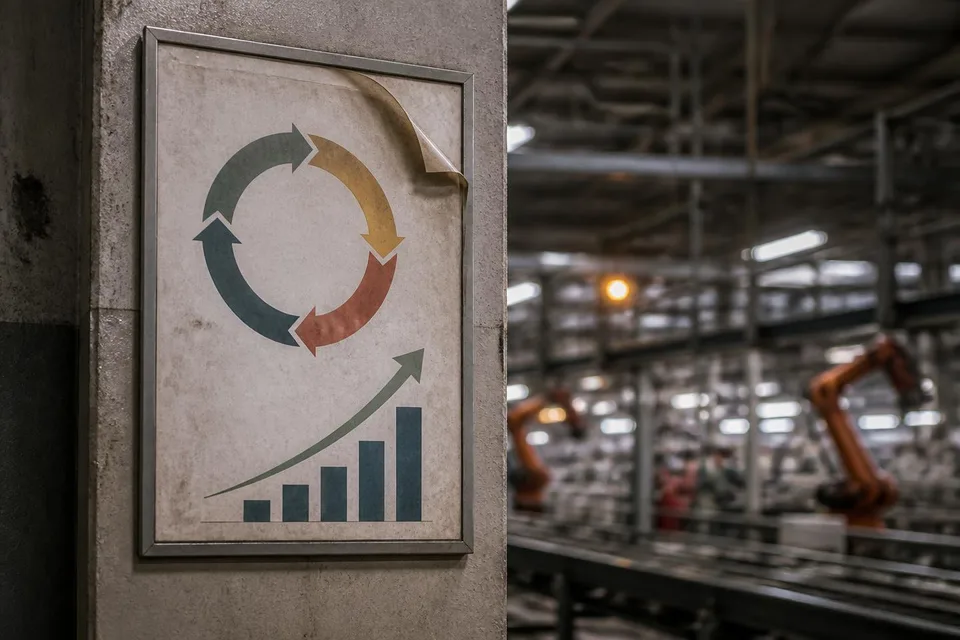
The third element is regular follow-up according to PDCA: plan, do, check, act. Not once a year, but at short intervals. Anyone who masters these three things is practising hoshin kanri, even without a single X-matrix.
Why corporate templates fail in mid-sized companies
I have experienced hoshin kanri in corporate plants and know how it is organised there. There are templates, deadlines, people responsible for maintaining the matrices, reviews at every level. It works because someone has the time for it.
In a mid-sized company nobody has that time. Plant management runs production and does lean on the side. Anyone who adopts the corporate template there gets a beautifully filled-in matrix that nobody updates after the first quarterly crisis. The instrument survives, the content does not.
The fault does not lie with hoshin kanri but with transferring the form instead of the substance. An SME does not need a matrix with dozens of fields. It needs one page that states the few goals, who is responsible for them and how progress will be recognised. And it needs a leadership team that genuinely looks at that page every month.
Step one: condense into a few breakthroughs
The hardest work takes place before the first goal: leaving things out. When I look at annual planning with management teams, I usually find a long list. Digitalisation, delivery performance, new products, cost reduction, young talent, sustainability, quality. All important, all at once.
Hoshin kanri demands a decision. Which few topics would, if they succeeded, move the plant furthest forward this year? My experience: it is rarely more than you can count on one hand, and often fewer. Everything else is not deleted but explicitly moved into daily business. That is a relief, because it answers the question of what is not a priority.
A plant with several assembly lines that I supported had launched a double-digit number of strategic initiatives the previous year. None was finished. In the workshop with the management team, a few breakthroughs remained at the end: delivery performance in the core segment and lead time in order processing. The rest was deliberately parked. The effect was not just focus, but palpable relief among the department heads.
Step two: catchball instead of cascade
Now the goals are not announced but negotiated. The management team brings the breakthroughs to plant and department management and asks: what can you contribute? What do you need for it? What stands in the way? The answers come back, the goals are sharpened. Then the same round goes one level down, all the way to the shift leaders and team leaders.
Catchball takes time, usually a few conversations per level. But it produces something that no cascade produces: understanding and commitment. Anyone who has helped formulate a goal knows it and carries it. Anyone who has merely received it waits and sees.
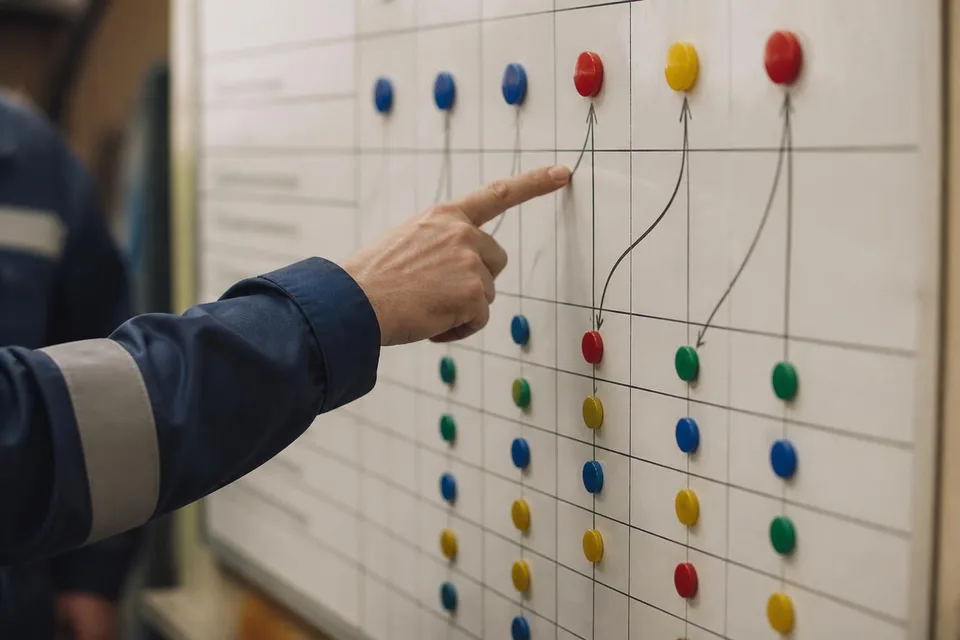
At the line it then looks like this: the shopfloor board does not show the company goal but the line's contribution to it, in its own language. If the plant wants to improve delivery performance, the line might show the stability of the weekly programme or the number of open disruptions. The link upwards is traceable, but the goal is tangible.
Step three: follow up monthly, without a flood of reports
Follow-up is the point at which most goal processes die. Not because nobody wants to, but because the format is too heavy. Reports are written instead of problems solved.
My suggestion for mid-sized companies: a monthly hoshin review, short, ideally in front of a wall rather than a screen. One A3 page per breakthrough goal: goal, KPI, status, deviation, next steps, obstacles. The person responsible reports in a few minutes, the group decides where support is needed. Done.
For this to hold, it needs rules: - The date is fixed and is not moved, not even for a customer escalation. - The discussion is about deviations, not successes. Green needs no airtime. - Obstacles that the team cannot solve itself are taken away by leadership and answered next time. - Goals may be adjusted during the year if the situation changes. But deliberately, in the review, not silently.
Hoshin kanri and OKR: which suits you?
Many management teams ask me whether they would be better off introducing OKR. The methods are related. OKR works with objectives and key results in shorter cycles, often quarterly, and comes from the software world. Hoshin kanri thinks in annual goals with monthly follow-up and comes from manufacturing.
For a plant, hoshin is usually the more natural framework, because production goals such as delivery performance or lead time take time and because the link to shopfloor management is direct. OKR can make sense in development or digitalisation teams, where learning happens in short cycles. Mixing the two is possible as long as the logic stays clear: few goals, dialogue, follow-up.
More important than the choice of method is the discipline of leadership. A simple hoshin that is lived every month beats any OKR tool that is abandoned after the second quarter.
How you can tell it is working
You do not notice it in the matrix but in the conversations. When a shift leader can explain why his line is working on the disruption rate and what that has to do with the plant's delivery performance, the compass needle has arrived. When the hoshin review no longer consists of reports being read out but of obstacles being removed, the process is alive.
And you notice it in what no longer happens. Fewer projects started in parallel. Fewer surprises in December. Fewer discussions about what the priority actually is, because the answer is on the wall.
You do not need a staff department for that. You need a management team that commits to a few goals, a plant management that leads the dialogue, and a monthly rhythm that is kept. That is hoshin kanri for mid-sized companies.
In short
- Hoshin kanri is a way of thinking, not a matrix: a few breakthrough goals, genuine dialogue between levels, regular follow-up.
- Corporate templates fail in mid-sized companies because nobody maintains them. One page per goal and a fixed monthly date are enough.
- The hardest work is leaving things out. Whatever is not a breakthrough is deliberately moved into daily business.
- Catchball instead of cascade: goals are negotiated, not announced. That creates understanding and commitment all the way to the line.
- In the review, deviations and obstacles count, not success reports. Green needs no airtime.
Frequently asked questions
Frequently asked questions
How many breakthrough goals should a mid-sized plant have per year?
So few that leadership has every single one in mind and can seriously follow up on it every month. In my experience that is usually far fewer than appear on the first list. What matters is not the exact number but that all other topics are explicitly classified as daily business and no resources compete with the breakthroughs.
Do we need software or an X-matrix for hoshin kanri?
No. The X-matrix is a tool for large organisations with many levels. For a mid-sized plant, one A3 page per goal on a wall is enough, supplemented by each line's contribution on the shopfloor board. More important than the tool is a living rhythm of catchball conversations and monthly reviews. Once that rhythm is in place, you can always add a tool later.
What happens if the situation changes fundamentally during the year?
Then the goals are adjusted, deliberately in the hoshin review, not silently in everyday business. Hoshin kanri is not a rigid annual plan but a PDCA cycle. A goal may be reformulated or replaced as long as the reasons are discussed openly and communicated to all levels. What must not happen is the quiet disappearance of goals because they have become inconvenient.