
A first workshop with an external facilitator is not a kick-off. It is a test. Not for the participants, but for the person you have brought into the building. On this day it is decided whether the plant experiences them as someone who listens and understands something, or as someone who brings slides and hands out terminology.
That is my thesis, and I stand by it even though it applies to me. In my years as a lean consultant I have run many first workshops, in corporate plants as in small businesses, and I know how much hangs on this one day. Plant management expects movement. The shift leaders expect the next programme that will pass by. The CEO expects the effort to pay off. All of them are right, and all of them are watching.
If you are bringing in someone from outside for the first time, or for the first time after a bad experience, it is worth taking a clear look at what a good first workshop can deliver, what it should deliberately not deliver, and how you can tell by the evening whether it was the right start.
What a first workshop is not
Let us first clear away the false expectations, because they are the most common source of disappointment.
A first workshop is not a training course. If the facilitator fills the day explaining the seven types of waste and the PDCA cycle, they have turned a day of your managers' time into a lecture. Fundamentals have their place, but not on the first day and not in front of people who have been standing at the line for years.
Nor is it a solution presentation. Nobody who saw your plant for the first time the day before can seriously tell you what needs to be done. Anyone who does so anyway is working with templates. And it is not a motivational event. If the mood at the end of the day is artificially high but nobody can name a concrete next step, it was theatre.
What remains sounds more modest and is harder: the first workshop is a joint stocktake with a clear result. It shows where the plant stands, what those involved can agree on and which first step follows.
The day before plays its part
A good first workshop does not begin in the training room. It begins the day before or in the morning on the shop floor. Whoever is facilitating you should have been beforehand where the problem arises: at the line, in the warehouse, in order processing, with the people who work there.
You should insist on that. A facilitator who walks straight from the car into the workshop works with what plant management has told them. That is one perspective, and rarely the complete one. Whoever stood with the early shift for an hour beforehand brings observations that trigger a different quality of conversation in the workshop: "I noticed this morning that on the second line the order was changed before the material was there. Is that familiar to you?" That sentence opens more than any slide.
The day before also includes a conversation with the client about the real reason. Not the official one that is in the proposal, but the one that keeps them awake at night. Delivery reliability, a conflict between areas, an upcoming relocation, a succession issue. The workshop is set up differently depending on what is really behind it.
What should happen in the room
I describe the flow as I design it, not as a norm, but as an example of what you may expect.
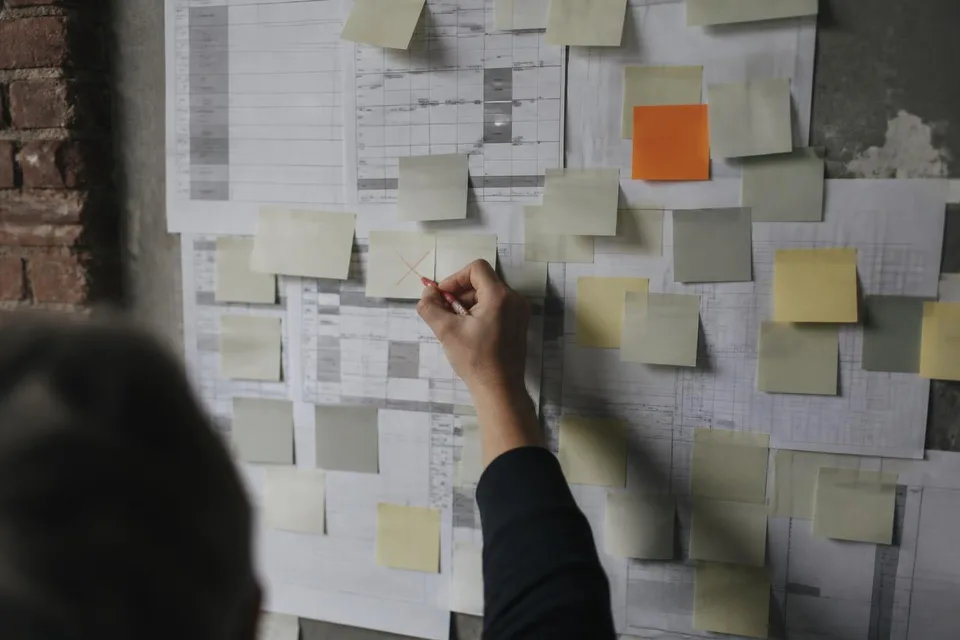
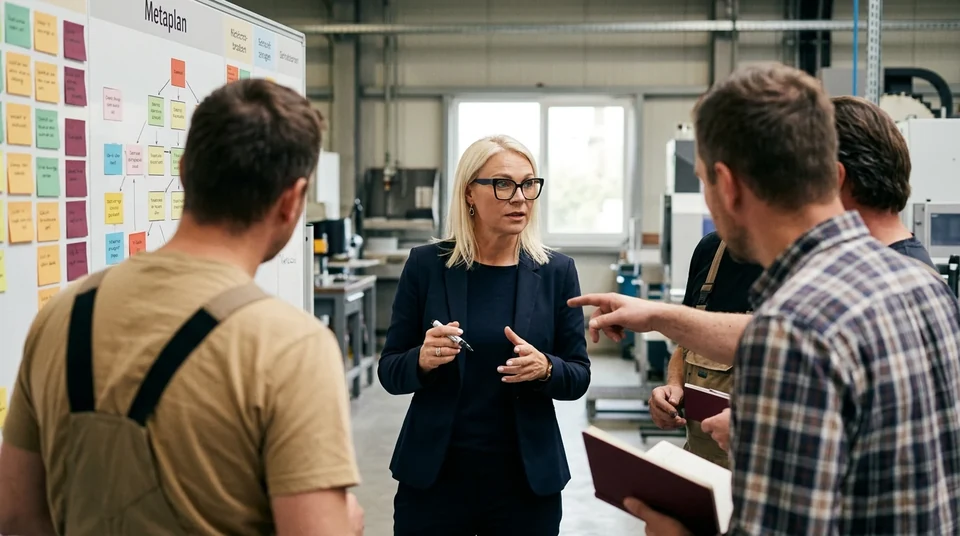
First, the question of why everyone is here is clarified, in the words of the participants, not in the words of plant management. That takes longer than you think, and it is the most important half hour of the day. Then the current state is described, jointly, on the wall, with the knowledge of everyone in the room. For a process topic that can be a rough value stream sketch, for a leadership topic a collection of situations where things stick. What matters is that the description comes from the participants and that at the end they say: "Yes, that is how it is with us."
Only then does it turn to causes. And here the quality of the facilitator shows: do they stay with the symptoms that are named first, or do they keep asking until the place becomes visible where something can be changed? A plant with several machining centres named "unreliable maintenance" as the problem in the first workshop. After several why questions, this stood on the wall: the fault reports came verbally, were not prioritised, and maintenance decided by volume of complaint. That was solvable. "Unreliable maintenance" was not.
At the end there is a small, concrete next step with a name and a date. Not the action plan with many lines. One step that becomes visible in the next few weeks and proves that the day triggered something.
How to recognise a good facilitator on the first day
There are signals I point clients to when they experience a facilitator for the first time:
- They listen more than they talk. If the facilitator has most of the speaking time, the room learns nothing about itself.
- They ask follow-up questions instead of interpreting. "What do you mean by that?" instead of "That is a classic interface problem."
- They can bear conflict. If production and planning clash in the room, they do not smooth it over but make the conflict the material.
- They promise nothing they do not know. No statements about what will have been achieved in a few months.
- They speak the language of the plant. Technical terms where they help, not as proof of competence.
- They do not let plant management off the hook. The result of the day belongs to the plant, not to the facilitator.
And a signal that many underestimate: they stay during the break. Whoever stands at the coffee during the break and talks to the shift leader learns there what was not said in the room. Whoever answers emails during the break misses half the workshop.
What you yourself have to contribute
A first workshop can only be as good as you allow it to be. That sounds harsh, but it is the experience of many years.
The CEO or plant management has to be in the room, and for the whole day. Not for the welcome, not for the close. Whoever leaves for the next appointment after the opening signals to everyone: this is important, but not for me. From that moment on, the participants are working on a topic they know the decision-makers have not heard.
You have to bear what is said. The first workshop is often the first place where things are spoken openly that everyone has known for years. That can be uncomfortable. Whoever justifies or deflects at that moment closes the space the facilitator has just opened. Note, ask, thank. The response comes later.
And you have to invite the right people. Not only the management level that describes the problem, but also those who experience it daily. A workshop on shift handover without shift leaders is a conversation about absent people.
The evening after
How do you tell by the evening whether it was the right start? Not by the mood. By three questions you can ask yourself.
First: have we learned something about our plant that we did not see that way before? Not necessarily new, often it is familiar things placed in context for the first time. Second: is there a concrete next step that someone with a name will implement by a date, and do you believe it will happen? Third: would the participants, including the sceptical ones, voluntarily come to a second session?
If you answer all three questions with yes, the day was good. If one of them is a no, raise it openly with the facilitator before the next session is planned. A good facilitator wants to hear that. They know the first workshop was a test, and they want to know whether they passed.
In short
- The first workshop is not a training course, not a solution presentation and not a motivational event. It is a stocktake with a result.
- Insist that the facilitator has been on the shop floor beforehand and has talked to the client about the real reason.
- A good facilitator listens more than they talk, can bear conflict and promises nothing they do not know.
- The decision-makers stay in the room all day and bear what is said. The response comes later.
- In the evening three questions count: did we learn something, is there a next step, would the sceptics come back?
Frequently asked questions
Frequently asked questions
How many people should take part in the first workshop?
Enough that all perspectives on the topic are in the room, and few enough that everyone gets to speak. In practice that is a group that can sit around one table and work on one wall. More important than the number is the mix: decision-makers, management level and people from the daily process. If one of these groups is missing, they are talked about instead of with.
Should the first workshop take place in the plant or off-site?
In the plant, with access to the shop floor or the office where the topic plays out. A workshop in which you can go to the line in between and look at something is worth more than any seminar room in a hotel. Off-site only makes sense if the topic concerns the management level exclusively and distance from daily business matters more than closeness to the process.
What if the facilitator does not convince on the first day?
Raise it directly, ideally the same evening or the following day. Name concretely what was missing: too much speaking time, too few follow-up questions, no tangible next step. A professional facilitator takes that on board and adapts. If the second session is the same, it is the wrong person, and it is better to end it early than after half a year.