
Your plant's project list is long. Digitalisation of order processing, a new KPI system, changeover optimisation on two lines, reorganisation of maintenance, a sustainability programme from head office, plus the ERP update. Every single project has a good reason. Together they add up to a plant in which everyone is busy and nothing gets finished.
I have seen this in group-owned plants and in mid-sized companies, in the hall and in the office. The symptoms are always the same: meetings in which status is reported instead of progress. Team leaders who are members of four projects and have time for none. And a leadership that no longer knows what it actually wanted first.
The solution is easy to say and hard to do: cut. This article describes how to do that without the people who got involved in the projects feeling their work was worthless.
Why too many projects are worse than too few
Lean knows three kinds of loss: muda, the waste in the process; mura, the unevenness; and muri, the overburden. An overcrowded project list is muri in its purest form. It overburdens exactly the people who keep the plant running: shift leaders, team leaders, experienced clerical staff.
The problem is not just time. It is the constant switching. Whoever works on changeover today, sits in the KPI workshop tomorrow and tests the ERP the day after needs a run-up at every switch. In manufacturing we call that changeover time. In the head it works the same way. Several projects in parallel mean more changeover and less value creation.
On top of that comes a second effect: projects that run for a long time lose their justification. The market has changed, the customer is gone, the sponsor has moved on. The project runs anyway, because nobody has ended it. I call that project dead weight, and it grows quietly.
The honest inventory
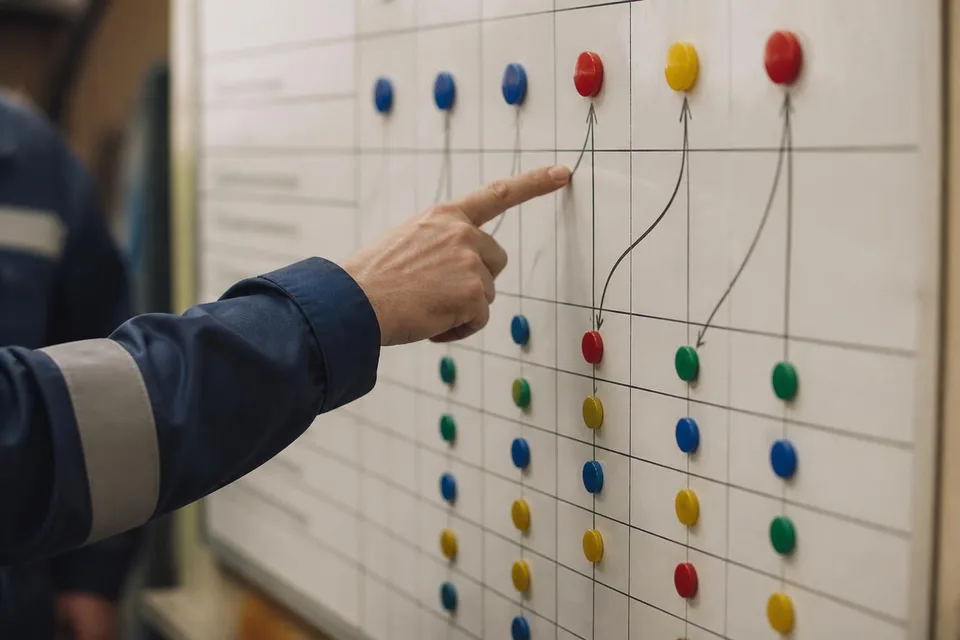
Before you cut, you need a list. That sounds trivial, but in most plants there is no complete one. There is the official project list of the executive team, plus the initiatives from head office, the initiatives of the departments and the things somebody simply started. All of it together on one board, with three columns: who drives it, what is it supposed to deliver, when was it last worked on.
The third column is the most interesting. At a plant with several assembly lines that I supported, the inventory turned up considerably more projects than plant management had in mind. For some of them, nobody could say any more when something had last happened. These projects were not dead, they were undead. They occupied capacity in people's heads without anything moving forward.
Do the inventory with the people involved, not over their heads. Whoever drives a project should say themselves what it delivers. That is the first step towards insight, and it is more honest than any scoring matrix.
Three questions for the cut list
To decide what stays, I use three questions. They are deliberately simple.
- Does the project move one of our value drivers? Lead time, delivery performance, quality, capacity. If nobody can explain the connection in one sentence, the answer is no.
- Would we still start it today? If the answer comes hesitantly, it is no.
- Who personally carries it, and does that person have the time for it? A project without an owner with capacity is not a project, but a wish.
Everything that gets two noes goes on the cut list. Everything that gets one no is paused, with a date for review. The rest stays, and so little of it that it can actually be done. My rule of thumb for plants without their own staff function: two to three initiatives at once, no more.
The same applies in the office. Digitalising order processing is a value driver. The new filing system for purchasing probably is not, as long as order clarification still runs by email.
Cutting without losing the people
This is the real core. Every project on the cut list had people who invested evenings and weekends. If you simply end it, you do not lose the project, you lose their commitment. And commitment is the scarcest resource in the plant.
Three things help. First: say clearly why. Not because the project was bad, but because the plant can only carry a certain number of initiatives and this one does not sit at the bottleneck. Second: acknowledge what was achieved, and do it concretely. Which insight, which interim result, which preparatory work remains usable. Third: give the people a role in what stays. Whoever proved themselves in a cut project is the first candidate for the value driver that now gets priority.
I have led laterally, without line authority. I could not take a project away from anyone, I had to convince. That taught me that the way you cut matters more than the decision itself. A project that is ended with respect leaves behind people who join in the next one. One that quietly fizzles out leaves behind cynics.
Leadership has to withstand the no
Cutting is uncomfortable, and the pressure comes from two sides. From inside, because every department defends its project. From outside, because head office or the executive team sends initiatives that have nothing to do with the plant's bottleneck.
Plant management therefore needs a language for the no. My recommendation: refer to the value drivers. We have committed to delivery performance and lead time in order processing. This initiative does not contribute to that, so it goes on the review list for next quarter. That is not an argument, that is focus. Towards head office it helps to have the focus in writing, in the sense of a hoshin kanri sheet with a few breakthrough objectives.
The no also has to apply to new ideas. Whoever cuts and then accepts everything again has only made room for the next wave. A simple mechanism: a new project only starts when another one is completed or cut.
What is different afterwards
I recognise plants that have cut consistently by one detail: the meetings get shorter. Instead of status rounds through twelve projects, there are deviation conversations about two or three. The team leaders know what has priority and no longer have to decide every day whom to turn down.
And something emerges that was missing before: finished things. A board that stands. An order process in which a double entry is really gone. A changeover that is shorter and stays that way. Finished things create trust, and trust is the basis for the next initiative. That is the real reason to cut: not to do less, but to bring something to completion.
In short
- Too many parallel projects are overburden in the lean sense: lots of changeover in people's heads, little value creation.
- First the honest inventory with everyone involved, then the cut list based on three simple questions.
- Cut with reasons, acknowledgement and a new role for those who got involved, otherwise you lose their commitment.
- Leadership needs a language for the no, internally and towards head office: value drivers instead of arguments.
- A new project only starts when another one ends. Finished things create the trust for the next one.
Frequently asked questions
Frequently asked questions
How many projects can a plant carry at once?
That depends on size and staff function, but fewer than most people think. For plants without their own operational excellence department, I recommend two to three real initiatives that contribute to the value drivers. Anything beyond that slows the whole thing down. What matters is that every initiative has an owner with actual capacity.
What do I do with projects mandated by head office?
First clarify what is mandatory and what is a recommendation. The room for manoeuvre is often bigger than assumed. For mandatory initiatives, set the timing so that they do not collide with your value drivers. And communicate the plant's focus upwards in writing. Most head offices respect a clear prioritisation; a vague everything-at-once, they do not.
How do I prevent the list filling up again after cutting?
With a simple rule: an initiative only starts when another one is completed or cut. Plus a regular review of the list, roughly quarterly, using the same three questions. And leadership has to withstand the no even for good ideas. Good ideas go on the review list, not on the start list.