01
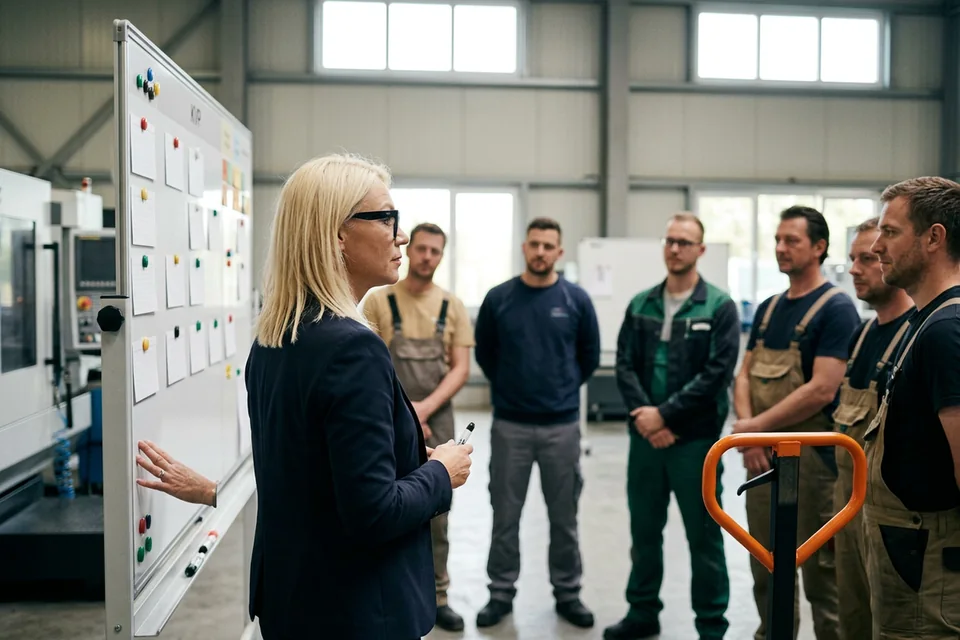
The shop floor board is on the wall, but the figures are from last week. The meeting takes place when there is time.
continuous improvement
CIP, the continuous improvement process, is the attitude that every process can get a little better every day, and that the people who carry it out know best where. In Japanese this is called kaizen. The methods of continuous improvement are well known: PDCA cycle, A3 report, 5-Why, Ishikawa, 5S, standard work. The problem is rarely the method but the missing rhythm.
Shop floor management provides this rhythm. It is a leadership system with four building blocks: key figures made visible at the place where value is created (shop floor board), daily regular communication routines in short stand-up meetings, structured problem solving for deviations, and leaders who are regularly present on the shop floor, for example in the Gemba Walk. The key figures come from safety, quality, delivery and cost, supplemented depending on the plant by OEE, lead time or inventory.
Continuous improvement without shop floor management remains a matter of chance. Shop floor management without continuous improvement becomes a reading of numbers. Together they create a plant that sees deviations on the same day and has eliminated them by the next.
Most plants have introduced continuous improvement at some point.
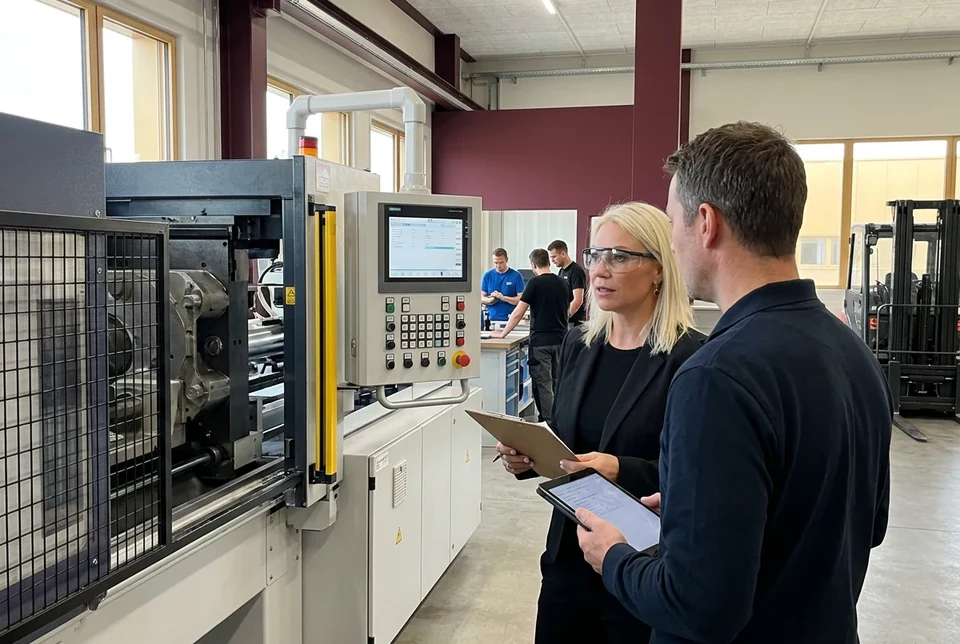
Introducing shop floor management does not mean ordering boards. It means establishing a leadership routine.
Where does the plant stand, which key figures move the business, what is already being measured? With plant management and production management.
A line or an area with a visible problem and a foreman who is willing.
Key figures, targets, deviation fields, action list. Handwritten, on paper, with the people who will use it. Digital boards come later, once the routine is in place.
Daily stand-up meeting with a fixed time, agenda and roles. A cascade from the line through the area up to plant management. I co-facilitate the first weeks and hand over step by step.
Foremen and shift leaders learn A3, 5-Why and PDCA on their own problem, not on a textbook example.
Short paths, fast evaluation, visible implementation. A suggestion that sits for three months is a lost employee.
After the pilot, the next areas, with regular shop floor audits so that the standard holds.
Not a concept for shop floor management, but a shop floor management system that is up and running:
Board standard with key figures, deviation logic and action list, adapted for each area.
Meeting cascade with times, agenda, roles and escalation rules, documented and trained.
Trained foremen and shift leaders who facilitate stand-up meetings and solve problems in a structured way.
Continuous improvement process with idea management, evaluation rules and implementation tracking.
Audit checklist for shop floor management, with which you check the standard yourself.
Measurable impact: fewer recurring disruptions, shorter response times, visible development in OEE and on-time delivery.
Intro call
You describe your starting point, I tell you openly whether and how I can help.

Frequently asked questions
CIP stands for continuous improvement process. It means a fixed routine with which a company improves its processes permanently in small steps, driven by the employees who carry out the work every day. The basis is the PDCA cycle: plan, do, check, standardise. CIP is the Western equivalent of the Japanese kaizen. Unlike a project, continuous improvement has no end; it is part of daily leadership, usually anchored in shop floor management.
Shop floor management is a leadership system that moves the control of production to the place where value is created. At its core are four elements: key figures that are visible to everyone on the board; short daily regular meetings in front of the board; structured problem solving for deviations; and leaders who are regularly present on site. The aim is that deviations are recognised and dealt with on the same day, instead of showing up in monthly reports. Shop floor management is the framework in which continuous improvement takes place every day.
Start with a pilot area and a foreman who is on board. Together with the team, define three to five key figures that really describe the area, and build a board for them, handwritten and simple. Set up a daily stand-up meeting of ten to fifteen minutes with a fixed time and agenda. Train the foreman in facilitation and in problem solving with A3 or 5-Why. Only when that is running do the next areas and the cascade up to plant management follow. The most common mistakes are too many key figures, no fixed time and leaders who do not show up.
A continuous improvement process follows the PDCA cycle. In the plan phase, a problem or an improvement idea is recorded, the cause is analysed and a measure is planned; in the do phase, the measure is implemented on a small scale. In the check phase, the effect is measured and compared with the target, and in the act phase the change becomes the standard if it succeeds, or the cycle starts again if it fails. In shop floor management, the open cycles are tracked on the board, with an owner and a deadline. What matters is that the loop is closed: a measure without a check of its effect is not an improvement.
Typical measures are small and fast: arranging tools at the workstation according to 5S so that search times disappear; building a changeover fixture that makes an adjustment unnecessary; relocating a material buffer so that walking distances become shorter; introducing a checklist that prevents a recurring error; standardising a handover between shifts. In the office they are templates that save duplicate data entry, or a rule for when an order counts as complete. Good improvement measures can be implemented in days, not months, and come from the employees themselves.
Gemba is Japanese for the place where things happen, in a plant the line or the workstation. A Gemba Walk is a leader's regular, structured walk to that place to observe, ask questions and understand, instead of judging from reports. It is not an inspection round and not a factory tour. The leader asks about the standard, about deviations and about obstacles, and listens. In shop floor management, the Gemba Walk is the element that connects leadership with reality.
OEE stands for Overall Equipment Effectiveness. It measures how much of a machine's planned operating time was actually used to produce good parts at the target cycle time. OEE is the product of three factors: availability (downtime), performance (speed losses) and quality (scrap and rework). An OEE of 60 % means that 40 % of the time is lost. On the shop floor board, OEE is a good lead indicator for machines, because it shows which of the three types of loss offers the biggest lever.
Usually for three reasons. First, evaluation takes too long: anyone who submits a suggestion and hears nothing for three months will not submit a second one. Second, idea management bypasses leadership, as a form sent to a committee instead of a conversation at the board with the foreman. Third, visible implementation is missing; ideas are collected, not realised. The solution is to integrate idea management into shop floor management: suggestions are discussed at the board, decided within a few days, and small ideas are implemented by the team itself.

45 minutes, no obligation. Tell me how your shop floor meeting runs today.