01
After the last lean project the boards stayed, but nobody in the plant can facilitate a workshop on their own.
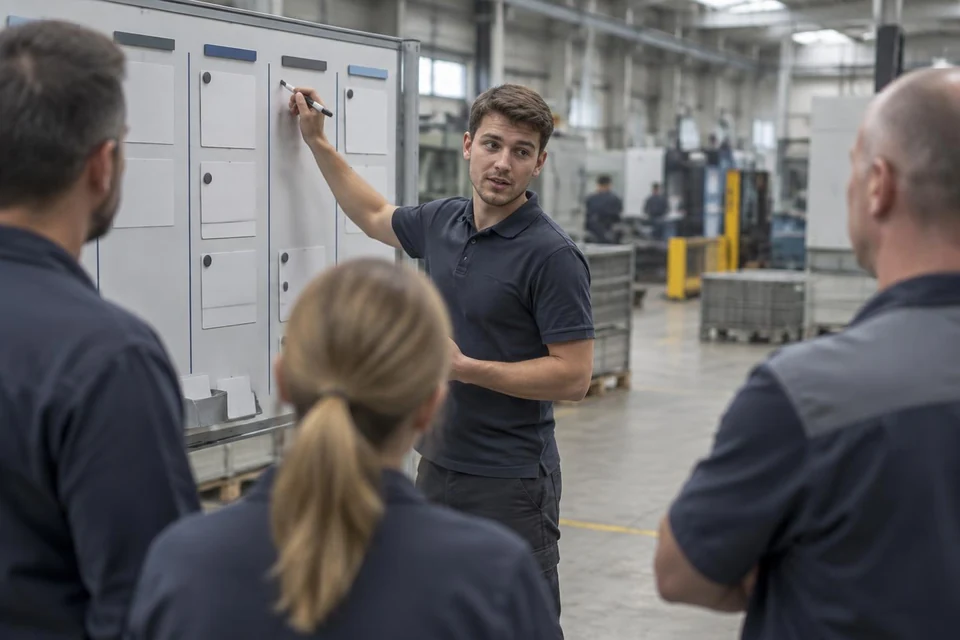
lean champion training
For me, competence building does not mean explaining methods. It means enabling people to apply them independently. Learning happens in your own project, not in a seminar room. That is why my training is staged: fundamentals and methods, then application to a real improvement project, then facilitating your own workshops with me alongside. I give feedback and step back one step at a time.
The content depends on the role. A future lean champion needs value stream mapping, A3 reports, 5 why, kaizen facilitation and the ability to set up a shop floor board. A foreman or team leader needs 5S, standardisation, audits and regular communication above all. A process owner in administration needs lean office methods for media breaks, approval loops and duplicate data entry.
On request the training closes with an internal audit and a confirmation documenting what the person has implemented independently. That is more practical than a certificate from a seminar provider, because it shows what was achieved in your own plant.

The knowledge is there as long as the external consultant is there.
Multipliers are not created in a week.
With senior management: who should carry improvement in future, with what share of their time and what backing?
Together we choose the participants. More important than prior knowledge is that the person is respected in the plant and is given time.
Methods applied to real processes in your own plant, in groups where everyone works and nobody just watches.
Each person takes on an improvement project in their area. I accompany, the person leads.
Participants facilitate their first workshops themselves; I am present and give feedback afterwards.
I document standards, hand over responsibility step by step and check with you after a few months whether the effect lasts.
A plant that carries improvement itself:
A training concept tailored to the roles in your plant: lean champions, CIP coordinators, foremen, process owners.
Staged in-house training, with methods applied to your own processes.
One completed improvement project per participant, with documented results.
Supported first workshops and audits, with personal feedback.
Documented standards and an audit rhythm your multipliers maintain themselves.
On request an internal confirmation showing what each person implemented independently.
Intro call
You describe your starting point, I tell you openly whether and how I can help.

Frequently asked questions
A lean champion is a person in the company who carries improvement methodically: maps value streams, identifies waste, facilitates workshops, maintains standards and guides teams in methods such as 5S, A3 or SMED. Just as important is the role as a mediator between senior management, plant management and employees. Large plants have their own lean departments; in SMEs one person often takes on this role alongside their line function.
That depends on size. In smaller plants a CIP coordinator with a fixed share of their time plus trained team leaders is often enough. From several hundred employees upwards a dedicated role pays off. More important than the position is that management takes the role seriously and gives it time. Without that, the lean manager becomes the person in charge of posters.
Because learning happens in your own project, the training runs over several months: fundamentals modules, a real improvement project, supported workshops and a closing audit. The on-site days are spread over this period. How many there are depends on the role and prior knowledge; we clarify that in the initial consultation.
No, and that is deliberate. On request the training closes with an internal audit and a confirmation documenting what the person has implemented independently in your plant. A university certificate does not replace that, but it is more practical. Anyone who mainly needs a title for their CV is better served by an open course.
People who are respected in the plant, enjoy working with others and are given time. Prior knowledge is secondary; methods can be learned. What matters is that the person is actually allowed to do improvement work after the training and does not disappear completely back into the line. I make this decision together with senior management before the training begins.
Yes, that is in fact the best case. If shop floor management is currently being introduced or a value stream analysis has produced measures, those measures become the participants' practice projects. Competence and results emerge at the same time, and the multipliers take responsibility from the start for something that counts in the plant.
I charge by effort or as a package for a training journey, including preparation, on-site days, project support and audit. I quote specific amounts in the free initial consultation, because training two CIP coordinators and training a group of multipliers across three plants are not comparable. Travel costs are shown transparently.

45 minutes, no obligation. Tell me who in your plant should carry improvement in future.