
Change rarely fails at the top and rarely at the bottom. It fails in the middle. That is not an accusation against department managers, foremen and shift leaders. It is a description of the position they are put in.
The executive board has decided on an initiative, say shopfloor management with daily routine meetings, or a new organisational structure in order processing. It has communicated it. The workforce has heard it and is waiting to see what happens. And in between sits a level that is supposed to implement the initiative while at the same time keeping delivery dates, covering sickness absences, settling the conflict on the line and writing the monthly report. This level did not invent the initiative, was usually not asked, and is first in line when it does not work.
Over many years in plants and offices I have learned that the middle is not the obstacle but the lever. Whoever understands it understands why change gets stuck. Whoever involves it properly has the strongest engine a plant has. In this article I show what happens in the middle and what executive management and plant management have to do differently.
The view from the middle
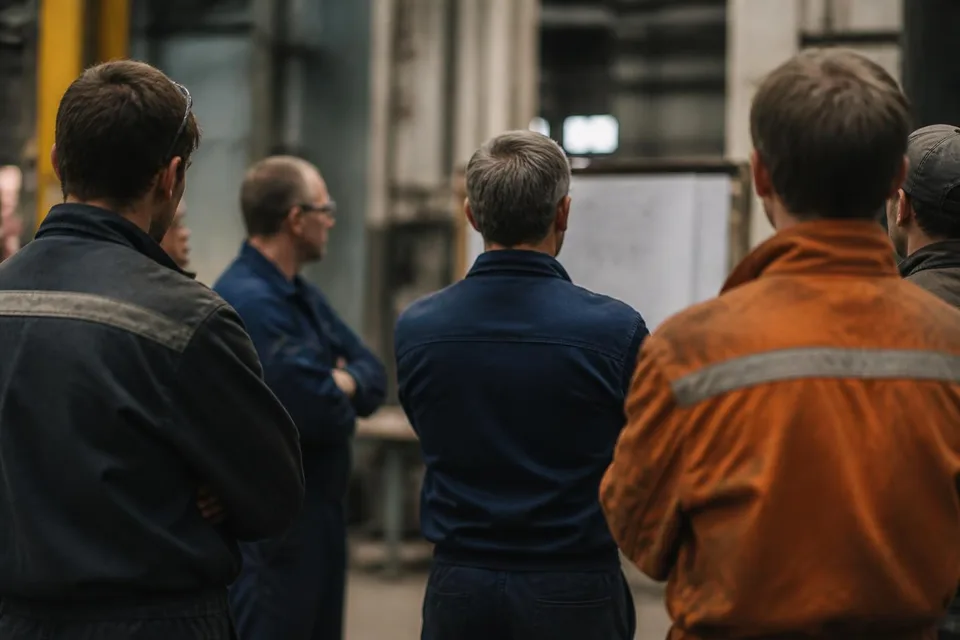
Picture a department manager in manufacturing, many years in the plant, risen from the line. In that time he has seen several programmes come and go. Each had a name, a kick-off, a poster. Each demanded time from him that he did not have. And with each, after a while, the executive board's attention had moved on, while he was left standing with the remains.
Now the next one comes. He hears the announcement and calculates in his head: what will this cost me in hours? Who in the team will dig in? How long will it take this time until nobody cares any more? That is not cynicism. That is experience, and it is rational.
Add to that the role conflict. Upwards he is supposed to represent the initiative. Downwards he is supposed to remain credible with people he has worked shoulder to shoulder with for years. If the initiative meets rejection on the line, he has to decide whose language he speaks. Most choose the line, because that is where they are every day. And the initiative becomes something you "go along with", not something you lead.
Four mechanisms that block the middle
When change gets stuck in the middle, I almost always find a combination of these causes:
- No involvement in the decision. The initiative was designed at the top, often with external help, and handed to the middle as finished. It is supposed to carry something it did not help to build. That works for simple instructions, not for changes that demand attitude.
- No time. Daily business carries on, in full. The initiative comes on top. In practice that means: it gets done when nothing else is on fire, and something is always on fire.
- No skill. A shift leader who is supposed to facilitate a routine meeting at the board has never learned to. He has learned to solve problems himself, not to get a team to make them visible. That is a different skill, and nobody taught it to him.
- No backing when it gets difficult. The department manager implements the initiative, meets resistance, escalates upwards, and is told he should be able to sort it out. Next time he does not escalate. He lets it run.
A corporate plant introduced shopfloor management that was exemplary on paper: cascade of boards, KPIs, escalation routes. After six months the meetings were taking place, but they lasted a few minutes, nobody named problems, and the action lists were empty. In conversation with the foremen it emerged: they had never learned to run the meeting, they had no time to follow up actions, and the one escalation they had dared had gone unanswered. The system was intact. Only the people in it had given up.
Why pressure from above makes it worse
The most common reaction of the executive board when an initiative hangs in the middle is insistence. Clearer announcements, tighter follow-up, sometimes consequences. That works briefly and harms for a long time.
Under pressure, the middle delivers what is measured. If the number of routine meetings held is measured, routine meetings take place. If filled-in boards are measured, the boards are filled in. What does not emerge is what it was all about: problems becoming visible, and teams solving them. You get form without content, and over time the form becomes a burden that everyone rejects together.
Worse still: pressure confirms for the middle exactly the picture it has of change initiatives. It is something the top wants and the bottom has to endure. The department manager who might have seen a good reason to make the initiative his own now has a better reason to treat it as an instruction. And instructions are carried out without being owned.
Involve the middle before the decision is made
The most effective step lies earlier than most people think. It lies before the decision.
When the executive board is considering an initiative, the middle is the first conversation partner, not the last recipient. Not in the form of information, but in the form of work: what is the problem we want to solve? How does it show in your area? What would help, what would not? These conversations cost weeks. They save years.
That does not mean the middle decides everything. The executive board sets the direction. But the design, the how in each department, belongs in the hands of those who carry it. Shopfloor management whose board structure the foremen designed themselves looks a little different in every hall and is lived in every hall. One that arrives as a template from head office looks the same everywhere and lives nowhere.
Hoshin kanri has the term catchball for this: goals are not announced but tossed back and forth between the levels until each level has translated them into its own language and can say what it contributes. That is not a ritual. It is the way responsibility comes into being.
Time, skill, backing: the three duties of leadership
Once the middle is involved, three things remain that only executive management and plant management can give.
Time. Whoever gives a department manager an initiative has to take something away from him. A reporting duty, a meeting, a task that someone else takes over. If nothing is removed, the initiative is in effect advertised as a spare-time activity, and that is how it is treated.
Skill. The ability to lead a team through change, to facilitate a routine meeting, to deal with resistance, can be learned, but it does not come by itself. It needs training that is close to everyday work, and support in the first weeks when things run bumpily. A foreman who gets feedback from someone after his third routine meeting learns more than in any seminar.
Backing. When the middle escalates, something has to happen at the top, and visibly so. An escalation that is answered generates the next one. One that fades away is the last. That also applies to conflicts with other areas: if the manufacturing department manager clashes with sales over the new workflow, he needs a plant management that takes up the conflict, not one that tells him to sort it out with his colleague.
The middle as engine
I have experienced plants in which the same level that was regarded as the brake for years became the carrier of change. The difference never lay in the people. It lay in how they were treated.
Where it succeeded, the executive board had done three things. It had involved the middle early and given it real design authority. It had freed up time for it, taught it skills and answered escalations. And it had made the middle's successes visible, not its own. When the foreman who built the first functioning routine meeting gets to present it to the executive board, and not the project manager, then something has shifted.
The middle management level is the only level that sees both every day: the strategy and the line. It knows what is wanted at the top, and it knows what is possible at the bottom. Whoever makes it a recipient throws away that knowledge. Whoever makes it a designer has the shortest path from decision to effect that a plant knows.
In short
- The middle is not the obstacle but the position it is put in: carry everything, decide nothing, first in line.
- Four blockers: no involvement, no time, no skill, no backing when escalating.
- Pressure from above produces form without content and confirms the picture that change is something to be endured.
- Involve the middle before the decision. Direction from the top, design from the level that carries it.
- Whoever gives an initiative has to take something away. And every escalation that fades away is the last.
Frequently asked questions
Frequently asked questions
What do I do with managers in the middle who openly reject the change?
First a one-to-one, with the question of what they experienced in the last programmes. Almost always behind open rejection there is a history of initiatives they were supposed to carry and that left them alone. Take that history seriously and say concretely what is different this time. Then give this person a design role, not an implementation role. Only if that changes nothing over a longer period is it a question of who holds the position.
How much time do I have to free up for the middle level for an initiative?
Enough that they can not only carry out the initiative but think it. Running a routine meeting takes minutes; following up the actions from it, refining with the team, coordinating with neighbouring areas takes hours per week. Those hours have to come from something else. Ask the people concerned themselves what can be dropped. They usually know exactly.
Should we run leadership training for the middle level?
Yes, but not as a seminar far from everyday work. What works is training on the person's own task: prepare their own routine meeting, run it, get feedback, improve. Supplemented by coaching in the first weeks when it gets difficult. Leadership training after which everyone goes back into unchanged structures is lost time, however good it was.