01
Production and sales, manufacturing and logistics, plant and head office: two areas that have been blaming each other for years.
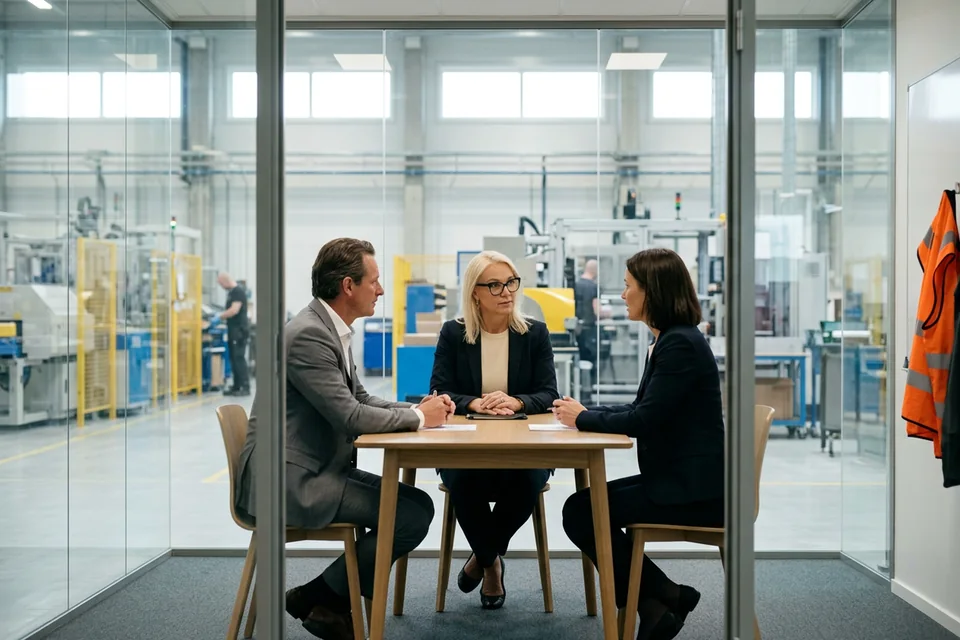
conflict management
Conflict management means recognising conflicts early, working through them objectively and resolving them so that collaboration afterwards is better than before. This is not an exercise in harmony. A good conflict makes a difference visible that has to be dealt with: an unclear interface, an unresolved role, a conflict over resources, a difference in values. Anyone who resolves the conflict without resolving the issue behind it has only postponed it.
I distinguish three levels. At the factual level, it is about processes, responsibilities and objectives; here clarification and agreement help. At the relationship level, it is about trust, recognition and hurt expectations; here you need a facilitated conversation in which both sides are heard. At the system level, it is about structures that generate conflict, for instance contradictory objectives of two areas; here the organisation has to change, not the people.
Most conflicts in plants have elements at all three levels. Conflict consulting therefore begins with the diagnosis of which level dominates, and with the choice of the appropriate format.

Conflicts rarely arrive as conflicts.

Conflict resolution with me follows a fixed sequence that provides security, especially when things get emotional:
A conversation with the client, usually the managing director, plant management or HR: what is it about, who is involved, what should be achieved at the end? I also clarify what is not part of the assignment.
Confidential conversations with everyone involved. Each person describes their view without the other side being present. This is where it is decided whether a resolution is possible and which format fits.
Facilitated, with clear rules: let people finish, perspective instead of blame, interests instead of positions. Usually half a day; for conflicts between departments, a workshop with both teams.
Concrete, written, verifiable: who does what differently from when? For interface conflicts, often as a handover agreement between the areas.
A follow-up session after four to eight weeks. Are the agreements holding? What needs adjusting?
A resolution that holds, and managers who deal with the next conflict themselves:
Conflict diagnosis after individual conversations, with an assessment of level, escalation stage and resolvability.
Facilitated clarifying conversations or workshops, impartial and confidential.
Written agreements between those involved, verifiable and with a follow-up session.
Conflict coaching for managers who have difficult conversations ahead of them.
Conflict management seminar for the leadership circle, in-house, working on your own cases.
Recommendations on structure where the conflict has organisational causes.
Intro call
You describe your starting point, I tell you openly whether and how I can help.

Frequently asked questions
Conflict management covers all the measures an organisation uses to recognise conflicts early, work through them objectively and resolve them so that collaboration works afterwards. It ranges from the ability of individual managers to hold difficult conversations, through facilitated clarifications between people or teams, to structural changes when the organisation itself generates conflicts. The aim is not the absence of conflict but a way of handling conflicts that makes them productive: a conflict that has been worked through usually reveals an unresolved role, interface or expectation that is better regulated afterwards.
Both are procedures in which a neutral third party leads the parties to a solution of their own. Mediation is the more formal procedure, with fixed phases, explicit voluntary participation, confidentiality and usually a written final agreement; it is used for escalated conflicts and where legal consequences are on the table. Conflict facilitation is more flexible and shorter, often a single facilitated conversation or a workshop, and suits most workplace conflicts between teams or departments. I work with the methods of both procedures and bring in partners for formal mediations.
Business mediation is mediation in a professional and corporate context: between shareholders, managers, departments, companies and suppliers, or in the course of a succession. The procedure follows fixed phases: assignment and rules, collecting topics, clarifying the interests behind the positions, developing options for a solution, agreement. The mediator decides nothing; they lead the process. In Switzerland and Austria, business mediation is the usual term for this procedure; in Germany people often simply speak of mediation. For conflicts with legal implications, I recommend a formal procedure with appropriately qualified partners.
When internal attempts have failed, when the manager is a party to it, or when the conflict has escalated to the point where those involved no longer speak to each other. Also when the conflict lies between two areas and any internal mediator would be seen as belonging to one side. Another signal is when the conflict generates visible costs: errors at the interface, sick notes, resignations of top performers. The earlier an external resolution begins, the shorter it is. A conflict at a low escalation stage needs a conversation; one at a high stage needs a procedure.
After clarifying the assignment with the managing director or HR, I hold confidential individual conversations with everyone involved, in which each person describes their view. Then I decide with those involved whether and in which format a joint clarification is possible. The joint conversation usually takes half a day, follows clear rules and leads from the accusations to the interests behind them and from there to concrete agreements. These are recorded in writing. After a few weeks, we check in a follow-up session whether they are holding. Everything stays confidential; the client learns the result, not the content of the conversations.
They learn to recognise conflicts early, before they escalate, and to distinguish the levels: is it about the issue, the relationship or the structure? They get to know their own conflict behaviour, which is usually avoiding or asserting, and expand their repertoire. They practise conducting difficult conversations in a structured way: prepare, describe your view, listen, clarify interests, agree. They learn to facilitate a conflict in their own team and to recognise when they should bring in external help. The seminar works with the participants' own cases and takes one to two days.
Do not ignore it and do not decide immediately. First talk to both individually and listen without taking sides; it often turns out that an unresolved responsibility or a hurt expectation lies behind the dispute. Then hold a joint conversation with clear rules: each person describes their view, the other listens, and then agreements are made together. You facilitate, you do not judge. Record the agreements in writing and check them after a few weeks. If you are part of the conflict yourself or the conversation fails, bring in a neutral person.
Yes, that is the foundation. What is said in individual conversations stays with me; I carry nothing from one side to the other unless the person expressly agrees. The client, for instance the managing director or HR, learns whether a resolution has taken place and which agreements were made, but not what was discussed in detail. I clarify these rules in writing at the start with everyone involved and with the client. Without this confidentiality nobody would speak openly, and without open speaking there is no resolution.

45 minutes, no obligation and confidential. Tell me where the friction is in your organisation.