01
A new line, a new department or a merger: people who do not know each other are supposed to be a team from Monday.
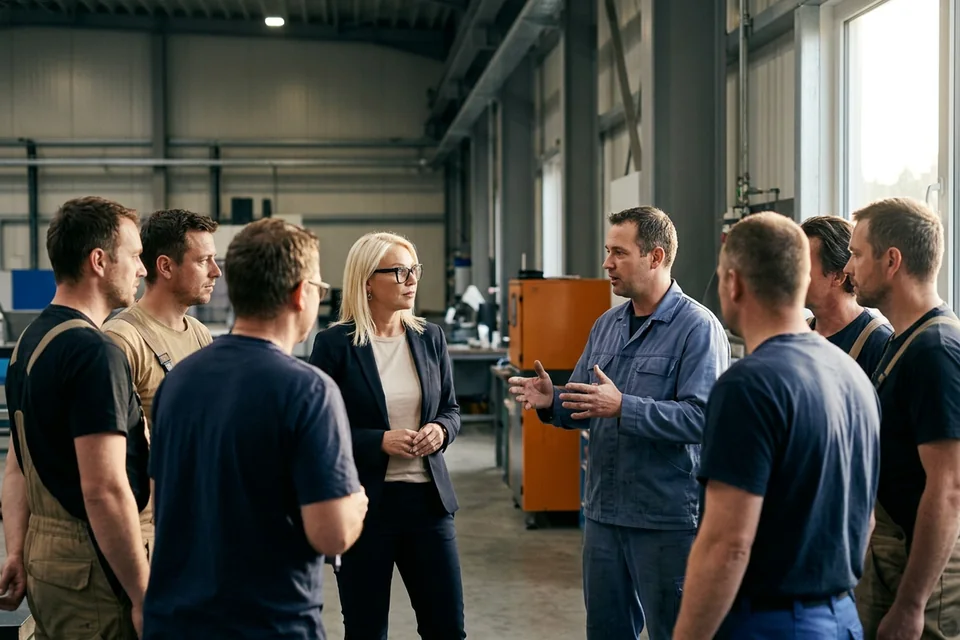
team development
For me, team development does not mean taking a team out of the business for two days and doing trust exercises. It starts from the work: from the shared goal, from the roles, from the handovers, from the way decisions are made and problems are discussed. The methods for this are well known; what matters is that they are connected to the real working day.
In a team development workshop we first clarify the mandate: what does this team exist for, how does it recognise that it is working well? Then the roles: who is responsible for what, where do responsibilities overlap, where does something get left undone? Then the collaboration: how is information passed on, how are decisions made, how is criticism expressed? And finally the agreements: specific rules that the team sets for itself and can follow through on.
Improving communication in the team is usually the core of this. Not because people cannot talk, but because the structures in which they do so are missing: a daily stand-up meeting, a board, a rule for feedback, a place for conflicts.

Team problems rarely arrive as team problems.
Team development without a diagnosis is a waste of time.
A conversation with the manager and, where there is one, the client about this: what should be different? How would you notice it?
Short individual conversations with team members, observation of a meeting or a shift handover, and if appropriate a short survey. I want to know how the team really works, not how it describes itself.
Based on the diagnosis, I design the workshop: objectives, methods, sequence. No standard programme, but what this team needs.
A one- to two-day team workshop or several shorter coaching sessions over a few weeks. I facilitate, the team does the work.
The team formulates its own rules, roles and next steps; I make sure they are specific and verifiable.
A follow-up session after four to eight weeks, in which the team checks what is holding and what needs to be adjusted.
A team that knows what it is there for and how it works together:
A diagnosis with the observations from conversations and meetings, prepared confidentially.
A tailor-made team workshop or coaching series, facilitated by me.
A team charter with mandate, roles, rules and decision paths, formulated by the team itself.
Specific agreements on communication: regular meetings, feedback, handling conflicts.
Methods taught that the team can then apply itself.
A follow-up session for review, so that the agreements hold.
Intro call
You describe your starting point, I tell you openly whether and how I can help.

Frequently asked questions
Team development is the targeted improvement of collaboration in a team: a shared goal, clear roles, reliable communication, constructive handling of conflicts and the ability to make decisions and implement them. It takes place in workshops, seminars or as longer-term team coaching, and starts from the team's real working day. Unlike a team building event, which above all strengthens the sense of community, team development changes the way the team works and leaves behind specific agreements that can be reviewed.
A typical workshop lasts one to two days and begins with a shared look at the team's mandate: what do we exist for, how do we recognise good work? Then comes the assessment of where you stand, usually based on my diagnosis from preliminary conversations: what is going well, what is not, what do we otherwise not say? The main part works on the two or three most important topics, such as roles, handovers or communication. At the end, the team formulates its own agreements and next steps. A follow-up session after a few weeks checks which of them are holding.
Team development is the umbrella term and is often carried out as a workshop or seminar over one to two days. Team coaching is a longer process in which I accompany a team in its real work over weeks or months: I sit in on meetings, reflect back observations and work with the team on specific situations. The workshop is suitable for starts, clarifications and realignments; team coaching for leadership teams, teams with deeper-lying conflicts or teams on the way to self-organisation. It often begins with a workshop and moves into coaching.
Usually not through communication training, but through structures. A daily stand-up meeting of ten minutes, in which everyone says what they are working on and where they are stuck, replaces many misunderstandings. A board on which the status of the work is visible to everyone replaces queries. An agreed rule on how and when feedback is given makes criticism normal instead of threatening. And a fixed place where conflicts may be raised, such as a monthly retrospective, prevents them from building up. Communication improves when it has a framework.
For clarification: mandate clarification, role clarification, team charter, alignment of expectations between team and manager. For collaboration: retrospectives, feedback formats, decision-making procedures such as consent, stand-up meetings and boards. For conflicts: conflict facilitation, structured clarification conversations. As a map, phase models of team development help to understand where a team stands, for instance in the orientation, conflict or performance phase. I select the methods based on the diagnosis; there is no standard programme for all teams with me.
Yes, and there it is often particularly effective, because production teams rarely get the opportunity to talk about how they work together. The formats have to fit shift operations: shorter units instead of two-day workshops, at the company instead of at a seminar hotel, with specific topics such as shift handover, roles on the line or dealing with disruptions. The introduction of teamwork is a classic case: a team takes on responsibility for planning, quality and improvement in its area and needs team development that grows with it step by step. I have supported this plant-wide.
A team workshop takes one to two days plus preliminary conversations and a follow-up session. Team coaching extends over two to six months with several sessions. The effect usually shows after the first workshop, but only lasts if the agreements are followed through, which is why the follow-up session is part of the package for me. Billing is on a time-and-materials basis at a day rate or as a fixed-scope package, transparent and monthly. We clarify the scope and the proposal in the no-obligation initial consultation; I give specific figures there.
That is more common than you might think, and not an obstacle. Often the manager sees a problem but the team does not, or the other way round. That is why I start with individual conversations in which everyone can say confidentially how they experience the collaboration. Usually it then turns out that there are topics that nobody raises in the group. The workshop is then not announced as problem solving, but as an assessment of where you stand: where are we, where do we want to go? If everything really is going well, that is a result too, and we use the time to secure it.
45 minutes, no obligation. Tell me which team is staying below its potential.