01
The company has grown, the organisation has not. The managing director still decides everything himself, and everyone waits for him.
organisational development
Organisational development means changing a company so that structure, processes, skills and culture fit together again. Usually one of them has grown and the rest has fallen behind. I support manufacturing companies in this, with a systemic view and with tools that work in the plant.
Organisational development is rarely planned.
Organisational development looks at a company as a whole: strategy, structure, processes, people and culture are connected, and whoever changes one of them changes the others with it. Systemic means taking exactly that seriously. A new organisation chart on its own changes nothing if processes, roles and decision paths stay the same. Conversely, every process optimisation fails if the structure behind it prevents people from taking responsibility.
Unlike change management, which supports a specific change, organisational development is about the company's ability to keep developing itself. This includes the organisational structure and process organisation, roles and responsibilities, employee development and skills building, knowledge management and knowledge transfer, and the leadership structure that carries all of this.
My organisational consulting is deliberately down to earth. I do not bring a theory of organisations with me, but the question of where work gets stuck in your company, who makes which decision and which knowledge is missing when someone leaves.
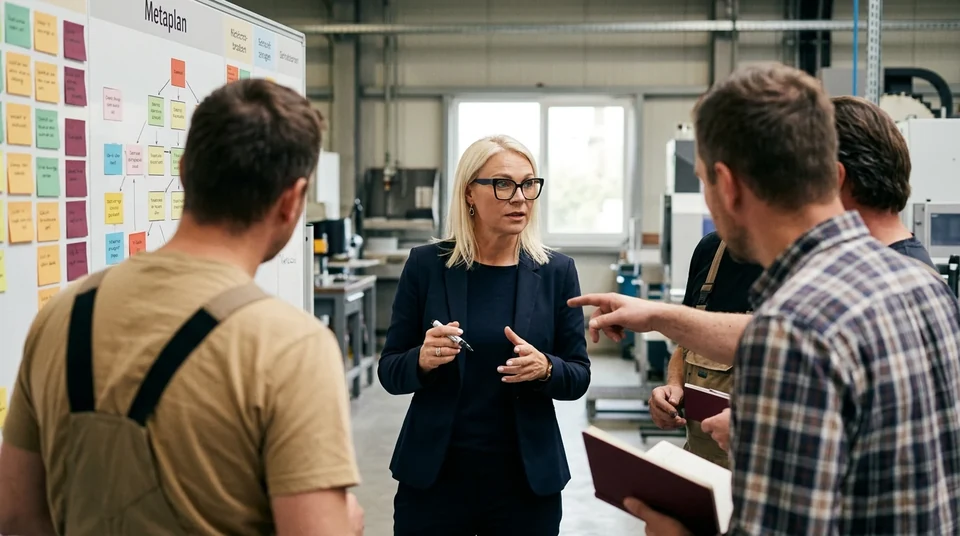

For me, organisational development starts with my Maturity Check: seven assessment areas, from governance through enablement, roles and resources to measurability, for the shop floor and the office each. The result shows where the organisation stands today and where it needs to go.
Individual and team conversations across all levels, stakeholder analysis, process and structure mapping. Where does work get stuck, who decides, what is missing?
Workshop with senior management: which organisation does the company need in three years? Structure, roles, decision paths, spans of control.
For every leadership and key role, a role profile with mandate, decision-making authority and interfaces. This is usually the most effective step.
A skills matrix per department: who can do what, who should be able to do what, where does the company depend on individuals? Employee development and knowledge transfer follow from this.
Not everything at once. Pilot department, learn, adjust, then the next department, accompanied by change communication.
Regular communication routines, leadership routines and reviews, so that the new organisation is lived and not just drawn.
An organisation that carries the load, and the ability to keep developing it:
Maturity profile and diagnostic report with prioritised fields of action.
Target picture of the organisation: structure, roles, decision paths, spans of control.
Role profiles for leadership and key positions with mandate and authority.
Skills matrix per department with development plan and knowledge transfer measures.
Implementation roadmap in stages, with communication plan and milestones.
Managers who understand and carry the new organisation, supported through workshops and coaching.
Intro call
You describe your starting point, I tell you openly whether and how I can help.
Frequently asked questions
Organisational development is the planned, long-term development of a company as a whole: its structure, processes, roles, skills and culture. Unlike a restructuring, which only changes the organisation chart, it involves the people who work in the organisation and aims to ensure that the company can keep developing itself in future. Typical triggers are growth, succession, new sites or markets, or the feeling among senior management that the organisation no longer fits the company's size. The tools are diagnosis, target picture, role clarification, skills development and supported implementation.
Systemic means viewing the company as an interconnected system in which every change has knock-on effects. Whoever introduces a new management level changes decision paths, communication and the self-image of the existing managers. Systemic organisational development therefore asks not only what should be changed, but how the system will react to it, and involves those affected early on. In practice, for me this means: diagnosis across all levels, observation of the informal structures, and implementation in stages, with feedback after each stage.
Change management supports a specific, clearly delimited change: a new line, a new ERP system, a merger. It has a beginning and an end and works with communication, stakeholder management and handling resistance. Organisational development is broader and longer-term; it develops the organisation as a whole and its ability to deal with change. In practice the two interlock: every organisational development contains change projects, and every major change project changes the organisation. I offer both and decide together with you which perspective your situation needs.
Because companies grow and their organisation often does not grow with them. What works by word of mouth with twenty people becomes a bottleneck with eighty: everything runs through the managing director, roles are unclear, knowledge depends on individuals. Organisational development creates structures that distribute responsibility and enable decisions where the information is. The benefit is measurable: faster decisions, less dependence on individuals, less friction between departments and a senior management that has time for strategy again. Not least, it is the prerequisite for succession and growth.
An organisational developer analyses how a company actually works, beyond the organisation chart: who decides, where does work get stuck, which informal rules apply? From this, they develop a target picture together with senior management and support the journey there. This includes workshops with managers and teams, role clarification, skills development, communication planning and the facilitation of the conflicts that arise with every change. A good organisational developer makes themselves redundant: they build up the ability of the company to keep developing itself in future.
A skills matrix is a table that shows, for one department, which employees have mastered which tasks and to what depth, usually in four levels from basic knowledge to trainer competence. It makes visible at a glance where the company depends on individuals, where the next generation is missing and who can train whom. On the shop floor it often hangs next to the board; in the office it sits with the department head. It is the basis for employee development, training planning, knowledge transfer before retirements and for shift planning that takes skills into account.
The starting point is a no-obligation initial consultation of 45 minutes in which we clarify your situation. You then receive a proposal with a clearly described scope: diagnostic phase, target picture workshop, role and skills work, implementation support. Billing is on a time-and-materials basis at a day rate or as a fixed-scope package, transparent and monthly. Depending on the size of the company, organisational development takes several months, with days on site and support in between. I give specific figures in the conversation, not on the website.
With a planned knowledge transfer that starts early. First, the skills matrix shows which knowledge depends on individual people and who should take it over. Then the knowledge is passed on in a structured way: documented standards and work instructions for what can be written down, and supervised working, tandems and handover periods for what cannot. What matters is a timeline of at least one year before the departure and one person who is responsible for the transfer. Knowledge management is not software, but an organised handover.
45 minutes, no obligation. Tell me what is crossing one desk too many in your company.