01
The managing director wants to do something with AI. What exactly, nobody knows, and the vendors present solutions for problems you do not have.

process digitalisation
My stance is simple: first the process, then the tool. A process that runs with media discontinuities, duplicate data entry and unclear responsibilities does not get better through AI, only faster at being bad. Process digitalisation therefore means first understanding, streamlining and standardising the process, and only then deciding which steps are automated or supported by AI.
For this I use the same tools as in process optimisation: process mapping with swimlanes, value stream mapping for office processes, and process mining, which reconstructs the actual flow from your system data. I'm certified as a Data Analyst for process mining; it is the most honest tool for seeing where a process really loses time and which steps are suitable for process automation.
Then comes the question of the right means. Much can be solved without AI: a form, an interface, a rule in the ERP system. For other things, classic automation is the right choice. And for tasks involving unstructured data, texts, documents, enquiries and variants, AI is the tool of choice. Digitalising processes means making this distinction cleanly.

AI has arrived in most plants, as a topic, not as a tool.
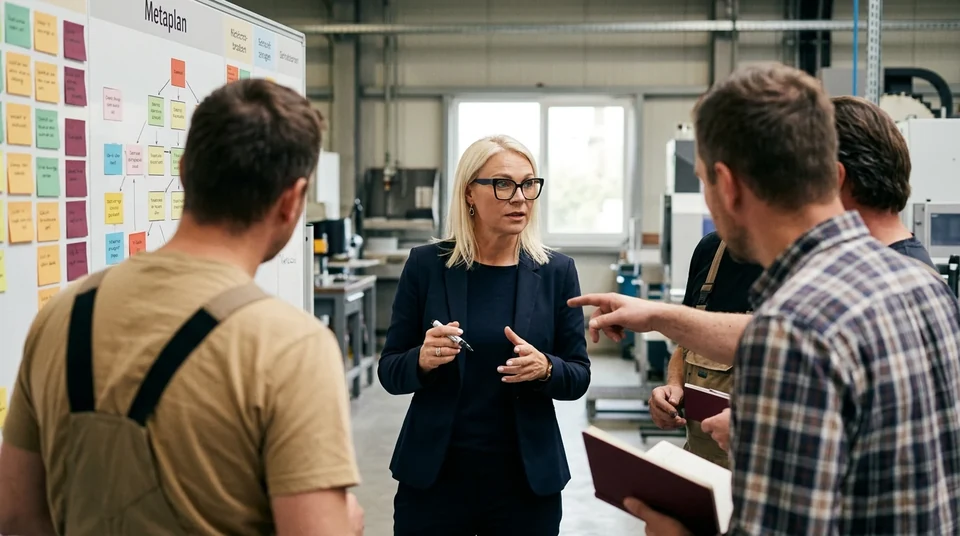
For me, introducing AI is a Lean and change project with a digital tool.
Where does the company stand in terms of processes, data, systems, skills and culture? My Maturity Check with a focus on the assessment area Digitalisation.
Workshop with the managing director and department heads: collect, assess and prioritise processes with high administrative effort. Select two or three pilots.
For each pilot, map, streamline and standardise the process. Process mining where data is available. Check data quality.
AI workshop for managers: what can AI do, what can it not do, how do you assess use cases, which rules apply? Training for the teams that work with the tools.
With your IT or an implementation partner from my network. I support the process and change part: adjust standards, clarify roles, sustain usage, measure impact.
Record the rules, name the people responsible, plan the next use cases.
AI that arrives in your processes instead of staying in a presentation:
AI readiness assessment as part of the Maturity Check, with concrete fields of action.
Prioritised use case list with benefit, data situation, risk and effort for each use case.
Streamlined, standardised and documented processes for the selected pilots.
AI workshop for managers and training for the teams affected.
Support for the pilot implementation in the process and change part, with measurement of the impact.
AI governance of an appropriate size: rules, people responsible, documentation.
Intro call
You describe your starting point, I tell you openly whether and how I can help.

Frequently asked questions
Fastest where people currently spend a lot of time on unstructured information: reading and answering enquiries, summarising documents, preparing quotations, writing reports, transferring data from emails and PDFs into systems, finding knowledge in manuals and instructions. In manufacturing companies, this concerns order clarification, purchasing, technical documentation, maintenance, quality and customer service. AI takes over the draft, the search or the pre-structuring, and the person checks and decides. The benefit is time freed up for value creation, and fewer errors caused by retyping. A use case analysis of your processes shows exactly where the biggest lever lies.
In five steps. First, check readiness, meaning data quality, systems, skills and culture; second, identify use cases, prioritise them by benefit, data situation, risk and effort, and select two or three pilots. Third, map, streamline and standardise the processes concerned before technology comes into play; fourth, train managers and teams and set rules for the handling of data and tools. Fifth, implement the pilots, support them, measure them, and only then roll out. The most common mistakes are starting with the tool instead of the process, and bypassing the people who are supposed to work with it.
Small, concrete and with rules. Choose a process that noticeably costs time and carries little risk, such as answering recurring enquiries, summarising reports or preparing quotations. Define which tools are permitted and which data may go in; without this rule, shadow AI emerges. Train the two to five people who will work with it, and after four weeks measure how much time was saved and what the quality is like. Only then move on to the next process. An AI workshop for senior management beforehand helps to assess the potential and limits realistically.
Rarely because of the technology. Usually because of four things: the process to be supported is not standardised, so the AI produces variants of the chaos, and the data is incomplete or scattered, so the tool delivers unusable results. The employees were not involved, see the AI as a threat or a gimmick, and do not use it. And there are no rules and no one responsible, so the pilot fizzles out as soon as the initiator turns to something else. All four causes are process and change issues, not technical ones; that is why I treat AI introduction as a Lean and change project.
Because without rules, two things happen: either employees secretly use AI tools with company data, with all the risks for data protection, trade secrets and quality. Or, out of uncertainty, they do not use them at all, and the potential is left untapped. AI governance defines which tools are permitted, which data may and may not go in, who checks results, how use cases are approved and who is responsible. For SMEs and mid-sized companies, a few pages and one responsible person are enough; what matters is that the rules are known and lived. Governance is the prerequisite for employees to be able to use AI safely.
This can be answered in five dimensions. Processes: are the workflows to be supported documented and standardised, and is the necessary data available digitally, completely and in one system, or scattered across emails and Excel? Systems: can your applications be connected, or are they closed? Skills: can managers assess AI use cases, and are there employees who can use the tools? Culture: are mistakes and experiments allowed, or is every innovation put on hold? I assess this AI readiness in the assessment area IT, Systems and Digitalisation of my Maturity Check and derive from it where you should start.
In the administrative environment: automatic capture and clarification of orders from emails and PDFs, quotation drafts from enquiries, summaries of supplier correspondence, searching technical documentation and work instructions by asking a question instead of browsing a folder structure, creating maintenance and quality reports from keywords, translating instructions for multilingual workforces. In planning: support for capacity and scheduling, detection of patterns in breakdown data. Closer to the machine: predictive maintenance and image-based inspection in quality, which however require specialists and good sensor data. For getting started, I recommend the administrative cases: low risk, fast impact, no new hardware.
An AI agency or AI service provider develops and implements solutions: they build the application, integrate it into your systems and operate it. AI consulting, as I offer it, works before and alongside the technology: it clarifies which processes are suitable, prepares these processes, defines rules, trains managers and teams and guides the introduction so that the solution is actually used. Both are needed, and both should not come from the same source, because a vendor who sells the solution cannot select the use cases neutrally. I work together with implementation partners and remain your neutral point of contact for process and change.

45 minutes, no obligation. Tell me where in your office the most time is lost to retyping and searching.